
- All
- Product Name
- Product Keyword
- Product Model
- Product Summary
- Product Description
- Multi Field Search
Views: 0 Author: Site Editor Publish Time: 2026-07-24 Origin: Site


Evaluating modern spec sheets often leads to immediate frustration. You start looking for a reliable cleaning tool, only to be bombarded by sudden, ultra-high "kPa" claims. Marketplace listings now boast numbers ranging from 30 kPa to an astronomical 100 kPa. Buyers are forced to make purchasing decisions based on isolated, often misleading metrics. It becomes incredibly difficult to understand how these numbers translate to real-world cleaning performance on carpets, hard floors, or stubborn pet hair.
Understanding the true vacuum cleaner kPa meaning is the first step in filtering out this marketing noise. Relying on a single inflated number rarely results in a clean home. This article provides a technical, evidence-based framework for evaluating suction power. We will compare kPa against Air Watts (AW) and CFM. By the end, you will know exactly how to identify the right specifications for your specific cleaning environments.

kPa Measures Static Pressure, Not Total Power: Kilopascals (kPa) indicate the maximum "pulling force" or sealed suction of a vacuum, representing the pressure differential created inside the machine.
The Conversion Metric: 1 kPa equals 1,000 Pascals (Pa). Brands switch between these two units to manipulate perceived power on spec sheets.
High kPa Does Not Guarantee Deep Cleaning: Without sufficient airflow (CFM) and mechanical agitation (brush roll design), a vacuum with a high kPa rating will still struggle to remove embedded dirt from carpets.
Beware of Extreme Claims (50 kPa - 100 kPa): Most ultra-high kPa claims on budget marketplace stick vacuums are measured under unrealistic laboratory conditions (e.g., directly at the sealed motor without cyclones, hoses, or filters attached).
Holistic Evaluation is Required: A confident purchase decision requires evaluating the interplay between suction (kPa), airflow (CFM), motor efficiency, and floorhead design rather than relying on a single isolated specification.
Table of Contents
Kilopascals (kPa) serve as a standard unit of pressure in physics. One kPa equals exactly 1,000 Pascals. In fluid dynamics, a motor creates a low-pressure zone inside the sealed system. The higher atmospheric pressure outside the machine then forces air into the intake. This pressure difference carries debris into the dustbin. The kPa rating measures the maximum potential of this pressure differential.
Industry professionals often refer to this as sealed suction or "water lift." Water lift measures how high a motor can pull a column of water up a completely sealed tube. Engineers measure maximum kPa at a dead stop. This means they completely seal the intake, resulting in zero airflow. However, a machine never operates completely sealed in the real world. If the airflow stops, you are no longer picking up dirt. Therefore, a maximum kPa rating represents an artificial ceiling rather than a practical working condition.
Think of kPa as the brute pulling force. Imagine sipping a very thick milkshake through a narrow straw. You need immense suction (kPa) to move the dense liquid against gravity. However, your pulling force is physically limited by the size of the straw's opening and the volume of liquid you can move at once. A motor might have high pulling force, but without enough air movement, heavy debris stays on the floor.
To better understand how this translates to physical components, consider the internal pathway of the air. The motor spins an impeller at high speeds, often exceeding 100,000 RPM in modern digital motors. This rapid rotation flings air outward, creating a void in the center. Air rushes in through the floorhead, up the wand, and through the cyclone assembly to fill that void. Every bend, filter, and narrow passage creates resistance. The initial kPa generated at the motor drops significantly by the time the suction reaches the floor.
Testing methodologies vary wildly between manufacturers. Reputable brands test the entire assembled unit. They measure the working suction at the cleaner head. Budget brands often test the bare motor on a test bench. They remove the wand, the dustbin, and the HEPA filters. This bare-motor test yields a massive kPa number that looks great on a box but means nothing for actual floor cleaning.
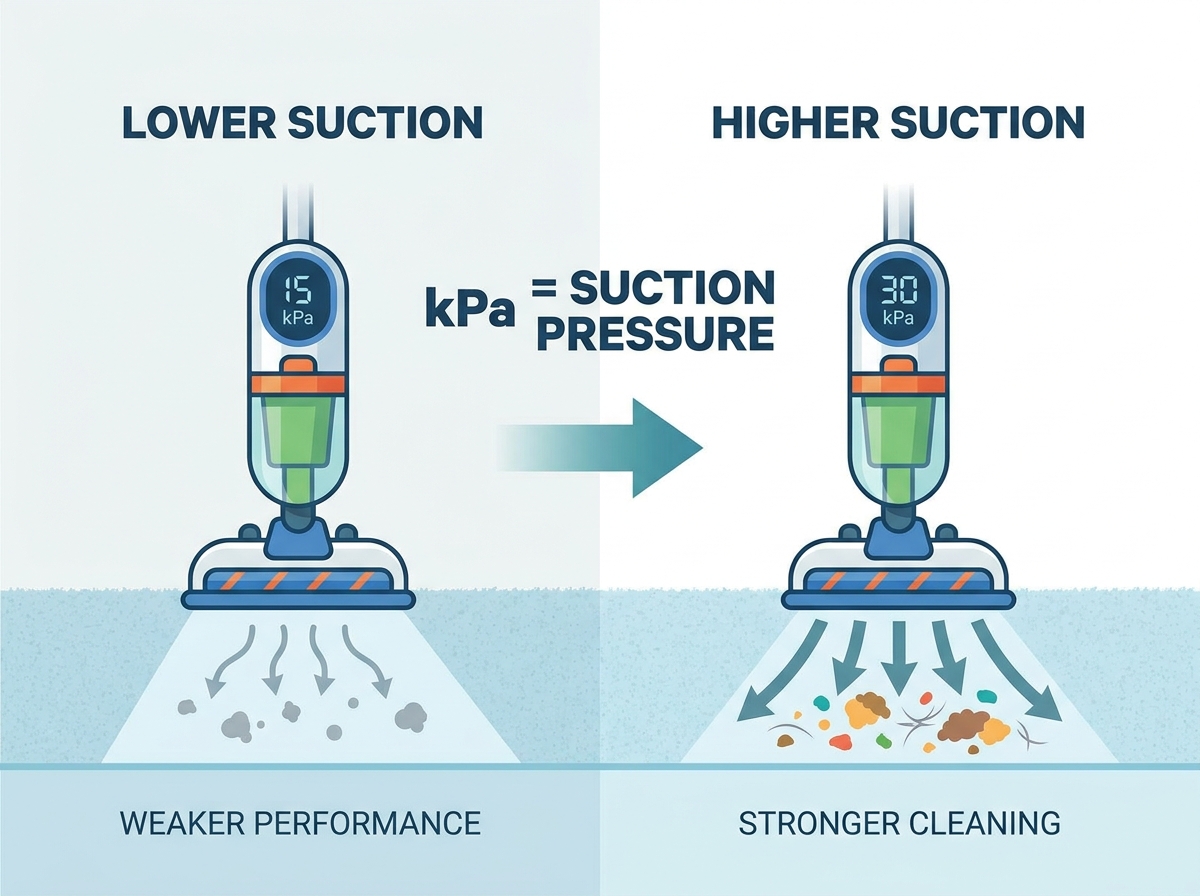
A massive spec war is currently happening across online marketplaces. Budget and direct-to-consumer brands frequently advertise 30, 40, or even 50+ kPa. Engineering realities make sustaining these numbers in a battery-operated stick model highly improbable. Generating that much static pressure requires tremendous energy. Attempting to hold 40 kPa on a cordless device leads to severe battery drain and rapid motor degradation.
You may have seen viral claims or listings advertising 100 kPa. A rating of 100 kPa is roughly equivalent to a perfect atmospheric vacuum. Achieving this is practically impossible for a consumer household machine. Brands achieve these deceptive ratings by measuring raw suction directly at the bare motor port. They test under zero-flow laboratory conditions. They completely ignore the massive performance drops caused by cyclones, HEPA filters, hoses, and floorheads.
Marketers also use Pascals to inflate numbers. Writing 30,000 Pa instead of 30 kPa is a psychological tactic. It creates the illusion of superior power. A premium brand might list a modest 150 Air Watts, while a budget brand flashes 30,000 Pa to look more impressive to uninformed buyers. The numbers look bigger, but the actual cleaning performance often falls short.
The missing variable in all these high-kPa claims is airflow. A motor can have immense pulling force. But if the intake opening is too small to move a high volume of air, it fails. High static pressure without high airflow will not transport debris into the dustbin effectively. It might stick to the floor, but it won't clean a wide path.
Consider the physical limitations of lithium-ion batteries. A standard 25.2V battery pack can only output a specific amount of wattage before overheating. Pushing a motor to generate 40 kPa draws massive current. The battery management system (BMS) will either throttle the power after a few minutes or allow the cells to degrade rapidly. This is why "Max" mode on high-kPa cordless models rarely lasts longer than eight minutes.
Manufacturers test bare motors without filters to inflate numbers.
Marketing teams convert kPa to Pa to add zeros to the spec sheet.
High static pressure claims ignore the necessity of airflow volume.
Sustaining high kPa on battery power causes rapid cell degradation.
Cubic Feet per Minute (CFM) measures airflow volume. CFM is the critical metric for cleaning hard floors. It determines how well a machine captures lightweight dust over a wider surface area. High CFM means the machine moves a lot of air, pulling in dust bunnies and pet hair from the edges of the baseboards.
Air Watts (AW) serves as the industry standard for overall cleaning power. It combines both suction and airflow into a single, reliable metric. The formula for Air Watts is: Air Watts = (Suction in Inches of Water Lift × Airflow in CFM) / 8.5. AW is a trustworthy, authoritative metric. It evaluates overall motor efficiency and actual cleaning capability because it requires both pressure and flow to achieve a high score.
Motor design requires conceptual trade-offs. There is an inverse relationship between suction (kPa) and airflow (CFM). When you restrict the opening to increase static pressure, you decrease the airflow volume. Premium brands balance these two metrics. They aim to achieve optimal Air Watts for practical cleaning. Budget brands often sacrifice airflow entirely just to achieve a high, marketable kPa number.
Metric | What It Measures | Best Use Case Indicator | Reliability as a Standalone Spec |
|---|---|---|---|
kPa (Kilopascals) | Static pressure / pulling force at a sealed dead stop. | Lifting heavy debris; extracting dirt from deep carpet fibers. | Low. Easily manipulated in lab settings without filters. |
CFM (Cubic Feet per Minute) | Volume of air moving through the system. | Sweeping hard floors; capturing light dust over a wide area. | Medium. Good for hard floors, but needs suction for carpets. |
AW (Air Watts) | Combined efficiency of suction and airflow. | Overall real-world cleaning capability across all surfaces. | High. The most accurate representation of motor performance. |
Understanding the balance between these metrics prevents poor purchasing decisions. A shop vac, for example, has massive CFM but relatively low kPa. It moves huge volumes of air to pick up sawdust and wood chips. A carpet extractor has high kPa but lower CFM. It needs the pulling force to extract water from dense fibers. A household floor cleaner needs a precise balance of both to handle mixed surfaces.

Different cleaning tasks require different specifications. A standard vacuum cleaner must be evaluated based on its intended environment. You cannot apply the same metric expectations to a robot as you would to a corded upright.
The main goal on hard floors is capturing surface dust and larger debris like cereal or pet food. You want to avoid the "snowplow" effect, where the floorhead pushes dirt forward instead of sucking it up. A moderate rating of 15-25 kPa is perfectly sufficient. Pairing this moderate suction with a soft fluffy roller is highly effective. A high kPa rating paired with a poorly designed, restrictive floorhead will just push debris around.
Deep carpet cleaning requires agitating, lifting, and pulling embedded dirt, sand, and pet hair out of medium-to-high pile fibers. This requires higher sustained suction. You typically need 20-30+ kPa, which is usually powered by corded electricity. This pulling force must work in tandem with aggressive brush roll agitation. The stiff bristles dig into the carpet backing, and the high kPa pulls the heavy grit upward.
Robot models are designed for autonomous surface-level maintenance. You will frequently see claims of 5,000 to 10,000 Pa (5-10 kPa). Robot manufacturers rely heavily on Pa marketing because the numbers look large. However, their actual cleaning performance depends far more on navigation software, side brush design, and the proximity of the suction port to the floor. A robot sitting millimeters from the hard floor needs very little static pressure to pick up dust.
Automotive detailing requires extracting heavy sand, gravel, and ground-in dirt from tight upholstery and deep footwells. Handheld units lack motorized brush rolls, so they rely entirely on raw suction. A minimum of 12-15 kPa is necessary to overcome the lack of mechanical agitation. Cheap 4-8 kPa models are only suitable for light surface dust on dashboards. They will fail to lift embedded sand from floor mats.
The physical point of contact matters more than the motor's static pressure. Floorhead and brush roll design dictate how well dirt enters the airstream. Look for anti-tangle fins for pet hair. Soft rollers are mandatory for delicate hardwood floors. Motorized agitation is non-negotiable for thick carpets. If the brush roll cannot lift the dirt, the motor's pulling force is irrelevant.
Filtration and sealed bodies present significant implementation risks. High-kPa motors pull air violently. If a unit has high suction but poor filtration, it creates a disaster. Unsealed seams or cheap HEPA filters will fail under pressure. The high pressure actively forces fine dust and allergens straight back into your room air. Always prioritize fully sealed systems over raw power.
Scalability and battery degradation are major concerns for cordless models. Running a device on "Max" mode to achieve the advertised 30 kPa comes with severe trade-offs. It often limits your runtime to a mere 5-10 minutes. Furthermore, constantly draining the battery at maximum discharge accelerates long-term battery degradation. You will likely need a replacement battery within a year.
Overall value depends on several influencing factors beyond the spec sheet. Check the warranty length. Verify parts availability for filters and brush rolls. Look for independent AW testing rather than trusting manufacturer labels. Read user reviews that specifically mention actual debris pickup, like sand or pet hair, rather than reviews praising the spec sheet claims.
When inspecting a potential purchase, look at the diameter of the wand and the hose. A wider diameter allows for higher CFM but requires a stronger motor to maintain kPa. If a brand advertises 40 kPa but uses a very narrow wand, they are choking the airflow to artificially boost the pressure reading. This design will clog easily with pet hair and large debris.
Understanding the true meaning of vacuum cleaner kPa is essential for choosing a vacuum that delivers real cleaning performance rather than impressive marketing numbers. Instead of focusing on suction pressure alone, evaluate airflow, Air Watts, floorhead design, filtration, and overall efficiency to find the vacuum cleaner that best matches your cleaning needs.
About SNDVAC
SNDVAC is a professional vacuum cleaner manufacturer specializing in the design, development, and production of high-performance cordless, handheld, upright, and wet & dry vacuum cleaners. With advanced manufacturing capabilities, strict quality control, and comprehensive OEM/ODM services, SNDVAC delivers innovative cleaning solutions that combine powerful suction, reliable durability, and user-friendly design for customers worldwide.
Compare kPa, Air Watts, and CFM together instead of relying on a single suction specification.
Choose suction power based on your flooring type, debris, and daily cleaning habits.
Pay attention to floorhead design, filtration systems, and battery performance for better real-world results.
Purchase products from manufacturers that provide transparent performance testing and reliable product support.
Before selecting a vacuum cleaner, evaluate suction efficiency, airflow, filtration performance, runtime, floorhead design, and overall build quality to ensure the best cleaning experience for your home or business.FAQ
A: For daily hard floor cleaning, 15 to 20 kPa is generally sufficient. For deep cleaning carpets or extracting heavy debris from car mats without a motorized brush, look for sustained suction above 20 kPa. Corded uprights often maintain 25 to 30 kPa easily.
A: Yes, 30 kPa is excellent for a cordless model, provided it is an accurate measurement of working suction. However, running a cordless motor at 30 kPa usually drains the battery in under 10 minutes. Use this max power sparingly for stubborn dirt.
A: There is no functional difference; it is purely a unit conversion. One kilopascal (kPa) equals 1,000 Pascals (Pa). Brands often use Pa to make the number look larger and more impressive on marketing materials.
A: Air Watts (AW) is significantly more important. AW calculates the overall cleaning efficiency by combining both suction (kPa/water lift) and airflow (CFM). It provides a much more accurate representation of how well the machine will actually pick up dirt in your home.
A: Not necessarily. While high static pressure helps pull dirt from deep fibers, it is useless without a good motorized brush roll. The brush must physically agitate and lift the carpet fibers. High pressure alone will just seal the floorhead to the carpet, stopping airflow.
A: Premium brands prefer to list Air Watts (AW) because it is a regulated, standardized metric that proves actual performance. They avoid the kPa spec war because raw static pressure numbers are easily manipulated by budget brands testing bare motors in laboratory settings.
A: Car upholstery holds onto pet hair tightly. Since most handheld car vacuums lack motorized brush rolls, you need strong raw suction. Aim for an absolute minimum of 15 kPa. Anything lower will struggle to pull embedded hair and sand from automotive carpets.


