
- All
- Product Name
- Product Keyword
- Product Model
- Product Summary
- Product Description
- Multi Field Search
Views: 0 Author: Site Editor Publish Time: 2026-07-24 Origin: Site


The modern floor-care market forces a strict compromise between ergonomic agility and sustained, raw suction power. Selecting the wrong vacuum architecture results in either inadequate deep-cleaning performance, leaving embedded dirt in carpets, or physical fatigue and storage friction that discourages regular use. Resolving the stick vacuum vs upright vacuum debate requires moving beyond marketing claims and evaluating both platforms against objective criteria: floor plan complexity, square footage, and physical constraints.
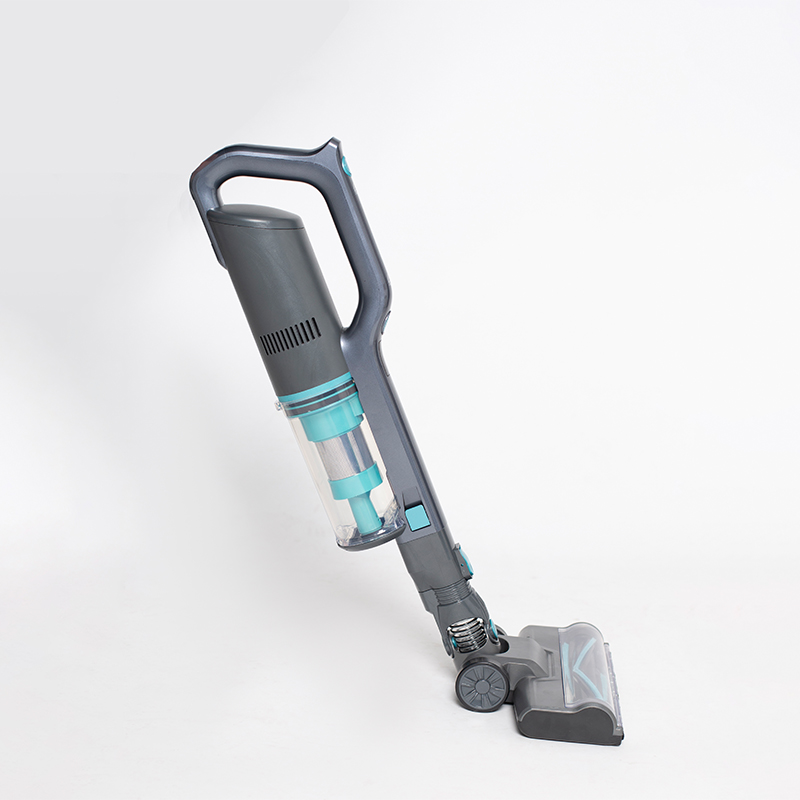
Performance Reality: Upright vacuums consistently deliver superior airflow (CFM) and agitation for high-pile carpets, operating without runtime limitations.
Ergonomic Trade-offs: Stick vacuums reduce the average carrying weight from a hefty 15 pounds down to under 8 pounds (with ultra-lightweight models starting at just 2kg / 4.4 lbs), optimizing for multi-level homes and daily spot-cleaning, but introduce battery degradation risks.
Capacity Constraints: Uprights offer significantly larger dirt bins or bags (often 2-3 liters), reducing maintenance frequency compared to the sub-1-liter bins typical of stick models.
Decision Framework: The optimal choice is dictated by the ratio of hard flooring to carpet, the presence of stairs, and the user's tolerance for ongoing battery maintenance versus cord management.
Table of Contents
Establishing the mechanical and structural differences between these two platforms dictates how each vacuum type interacts with different environments. The architecture of a vacuum cleaner directly influences its center of gravity, maneuverability, and raw power output. Understanding these baselines prevents mismatched expectations when deploying the equipment on different floor surfaces. You need to know exactly what you are pushing across your floors.
The modern stick vacuum is engineered for rapid deployment and maximum mobility. The design architecture typically locates the motor and dustbin near the handle. This creates a top-heavy but highly maneuverable profile. Some variations place the motor near the base for a lower center of gravity. The streamlined, compact nature remains consistent across the category. This structural approach prioritizes agility over bulk.
Power sources for these units are predominantly lithium-ion batteries. This offers cordless freedom that transforms how users approach daily cleaning tasks. While corded variants exist, the cordless format dominates the market. Weight is a defining characteristic. These units are highly portable. They range from ultra-lightweight 2kg (4.4 lbs) models up to roughly 8 pounds. Storage solutions often involve wall-mounted charging docks. This maximizes floor space in tight environments like apartments or crowded utility closets.
The wand design allows for modularity. You can detach the main floor head and wand to use the motor unit as a handheld device. This flexibility is excellent for cleaning upholstery, car interiors, and tight corners. However, the compact size limits the size of the motor and the dirt bin. You trade sustained power and capacity for the ability to carry the unit with one hand.
The upright vacuum represents the traditional standard for heavy-duty floor care. Its design architecture consists of an all-in-one vertical unit. The motor, dirt bin or bag, and cleaning head are stacked over a wide, highly stable base. This configuration allows for larger internal components. You get robust brush roll motors and extensive filtration systems without compromising the structural integrity of the machine.
These units rely exclusively on corded power. They provide continuous 120V mains electricity. This direct power line eliminates runtime anxiety. It allows for sustained, high-torque motor operation. The trade-off for this power is a bulkier construction. The weight class typically averages around 15 pounds. Heavy-duty models reach 18 pounds or more. This substantial mass limits immediate mobility. Lifting the unit becomes a deliberate physical effort.
The wide cleaning path of an upright means you cover more square footage with each pass. The heavy base presses the brush roll firmly into carpet fibers. This mechanical action is necessary for dislodging heavy dirt and pet hair that settles near the carpet backing. You push the weight across the floor rather than carrying it in your hand.
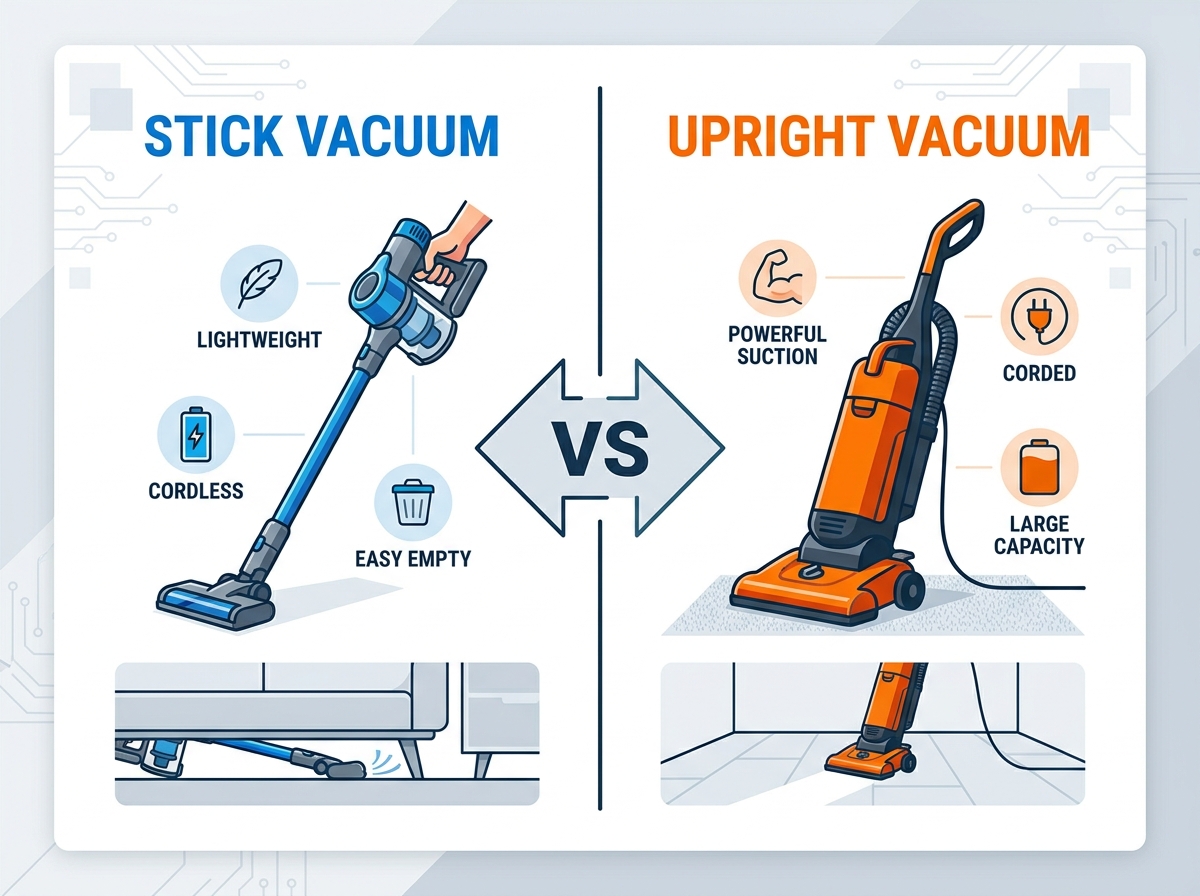
Evaluating vacuum cleaners requires looking past aesthetic design. You must focus on the mechanical specifications that drive cleaning performance. Suction power, dirt capacity, and spatial maneuverability are the primary dimensions that dictate real-world effectiveness. A machine that looks sleek might fail completely on a thick rug.
Cleaning efficacy relies on a combination of Air Watts (AW) and Cubic Feet per Minute (CFM). CFM measures the volume of air moving through the system. This directly correlates to picking up heavy debris. Corded uprights deliver sustained power delivery. They maintain peak CFM from the moment they are turned on until they are powered off. They do not suffer from performance drops as long as the filters remain clear.
Battery-operated stick models often rely on tiered power modes. You typically see Eco, Standard, and Boost settings. Boost mode can rival the suction of a full-sized unit. However, it rapidly depletes the battery. Power often fades as the charge drops. Motorized brush roll torque is also necessary for carpet agitation. Uprights utilize heavy, aggressive brush rolls driven by dedicated belts and motors. These separate carpet fibers effectively. Lighter models use softer, less aggressive agitation to conserve battery life.
The internal ducting of an upright is generally wider. This reduces the chance of clogs when picking up large debris like cereal or leaves. Stick models have narrow wands. They clog more easily if you try to vacuum up large volumes of debris at once. You have to be more selective about what you run over with a battery-powered unit.
The volume of debris a vacuum can hold dictates how often you must stop cleaning. Standard upright bins and bags range from 1.5 to 3 liters. This massive capacity is ideal for large homes. It handles environments with heavy debris accumulation easily. Stick models feature much smaller bins. They typically range from 0.3 to 0.9 liters. You will find yourself emptying these bins frequently during extended cleaning sessions.
Filtration integrity is another major factor. Bagged uprights generally provide superior, zero-exposure dust disposal. When you remove a sealed bag, allergens remain trapped. Bagless stick designs require dumping loose dirt into a trash can. This often releases a cloud of fine dust back into the air. Many lightweight chassis designs implement HEPA filters. However, the risk of air bypass is higher in compact, plastic-heavy builds. Dirty air can escape through unsealed seams before reaching the filter.
Maintaining the filters on a bagless unit is a messy job. You have to wash the foam filters regularly and wait 24 hours for them to dry. If you put a damp filter back into the machine, you risk destroying the motor. Bagged uprights bypass this issue entirely. The bag acts as the primary filter. You throw it away and start fresh.
Physical agility determines how easily a vacuum navigates complex floor plans. Uprights utilize either fixed wheels or swivel steering mechanisms. Their bulkier construction fundamentally limits physical agility around tight corners. They struggle in dense furniture arrangements. They require a wider turning radius and more physical effort to redirect.
Stick designs excel at lay-flat capabilities. The slim wand and low-profile cleaning head allow them to reach deep under low-clearance furniture. You can easily clean under beds and sofas. Upright canisters often obstruct this deep reach. The main body stops the vacuum from cleaning the center of the space beneath a bed. The physical footprint of a stick model allows for tight turns. You can make quick transitions between crowded rooms.
Feature | Stick Vacuum | Upright Vacuum |
|---|---|---|
Average Weight | 4.4 - 8 lbs | 14 - 18+ lbs |
Power Source | Battery (Cordless) | 120V Mains (Corded) |
Dirt Capacity | 0.3L - 0.9L | 1.5L - 3.0L |
Best Suited For | Hard floors, stairs, quick cleanups | High-pile carpets, large open spaces |
Under-Furniture Reach | Excellent (Lay-flat design) | Poor (Obstructed by main canister) |
No vacuum operates in a vacuum. The specific flooring materials and architectural layout of your environment dictate which machine will perform efficiently. Matching the tool to the terrain prevents frustration and ensures a clean home.
Upright models dominate the high-pile carpet category. The heavier cleaning head weight physically presses into the carpet pile. This creates a tighter seal for airflow. Combined with aggressive brush bristles and sustained high suction, these machines effectively pull embedded dirt from deep within the carpet matrix. They extract dander and heavy pet hair that settles near the backing.
Lighter machines simply glide over the top of dense carpets. They pick up surface litter but miss the heavy grit trapped below. Over time, this left-behind grit acts like sandpaper. It wears down the carpet fibers and degrades the flooring. If you have thick carpets and shedding pets, you need the mechanical weight and sustained airflow of a corded upright.

Stick models often win on hard surfaces. Many feature specialized soft roller attachments designed specifically for hardwoods and tile. These rollers capture fine dust without scattering larger debris. Fast-spinning, stiff-bristled uprights often kick debris across bare floors. The lighter wheels and reduced overall mass of a stick model significantly lower the risk of scratching delicate floor finishes.
When cleaning tile floors with deep grout lines, you need a machine that seals well against the hard surface. A soft roller head on a stick model creates an excellent seal. It pulls fine dust out of the grout lines effectively. Heavy uprights with aggressive bristles tend to bounce over hard floors, breaking the suction seal and leaving dust behind.

The logistical challenge of carrying a 15-pound machine up multiple flights of stairs cannot be overstated. It introduces a risk of muscle strain. It makes cleaning multi-level homes a daunting chore. Balancing a heavy upright on a narrow stair tread is dangerous and ineffective.
Stick models offer modularity. By removing the main wand, they convert into a handheld mode. Utilizing an ultra-lightweight 2kg build allows users to clean individual stair treads safely. You can move efficiently without the physical burden of balancing a heavy machine. You can attach a motorized mini-tool to clean carpeted stairs thoroughly with one hand.
Evaluating the long-term viability of floor care equipment requires looking past the initial purchase. You must understand the ongoing maintenance requirements and the structural lifespan of the unit. Machines break down if not maintained properly.
Both categories span from entry-level budget models to premium, high-end machines. Uprights generally utilize heavier plastics and metal components. They provide a robust build quality that withstands aggressive daily use. The motors are larger and run cooler. The drive belts are thick and designed to handle heavy resistance from thick carpets.
Stick models rely on miniaturized digital motors. These motors spin at incredibly high speeds to generate suction. This creates heat and stress on the internal components. The lightweight plastics used to keep the overall weight down are more prone to cracking if dropped. The complex electronics required to manage battery discharge add potential failure points that do not exist in simple corded machines.
Upright maintenance involves predictable, straightforward tasks. You must periodically replace bags, drive belts, and standard filters. These components are widely available. Changing a belt takes a screwdriver and ten minutes. Replacing a bag takes ten seconds.
Stick maintenance involves managing lithium-ion battery degradation. Batteries lose their ability to hold a full charge over time. They typically require replacement every two to four years, depending on charge cycles. You also have to wash the primary filters regularly to maintain suction. If you neglect filter maintenance on a bagless stick model, the motor will overheat and fail prematurely.
Check the brush roll weekly for tangled hair and cut it away with scissors.
Wash the pre-motor filter on bagless models once a month with cold water.
Allow all washed filters to air dry for a full 24 hours before reinstalling.
Inspect the wand and floor head neck for clogs if suction drops suddenly.
Replace the HEPA exhaust filter annually to maintain air quality.
Deploying either vacuum architecture introduces specific logistical risks. Identifying these challenges early allows for proper mitigation. This ensures the chosen equipment integrates smoothly into your routine.
Stick models often require drilling into walls to install charging docks. If you live in a rental property, drilling rules may prohibit this installation. You might end up leaning the vacuum in a corner where it can easily fall over and break. Uprights do not require wall mounting. However, they demand dedicated floor space in a closet due to their bulkier frame.
To mitigate storage friction, assess your rental agreements regarding wall mounts. Evaluate your available floor footprint versus vertical wall space before committing to a purchase. If you cannot wall-mount a stick model, look for versions that come with a freestanding floor dock.
While uprights are heavy to lift, their weight rests entirely on the floor during use. You push the weight; you do not carry it. Top-heavy stick models place the motor and battery weight directly on the user's wrist and forearm. This causes severe fatigue during extended cleaning sessions.
Mitigate this by testing the pivot weight of cordless models in-store. See how it feels to maneuver the floor head around chair legs. If you have wrist issues, opt for self-propelled uprights. These use motor assistance to drive the machine forward, requiring very little effort to push.
Cordless machines introduce runtime anxiety. High-suction Boost modes drain a fully charged battery in under 10 minutes. This leaves large homes half-cleaned and forces hours of recharge time. You cannot finish the job if the battery dies.
To mitigate this risk, purchase models that feature removable, swappable batteries. This allows you to keep a spare on the charger. Alternatively, retain a basic corded vacuum as a reliable backup for deep-cleaning days. Use the cordless unit for daily maintenance and the corded unit for weekly deep cleans.
The decision between a stick vacuum vs upright vacuum should be based on your home's layout, flooring types, cleaning frequency, and daily convenience requirements. By balancing cleaning performance, maneuverability, maintenance, and long-term durability, you can choose a vacuum cleaner that delivers the best value and cleaning results for your specific needs.
About SNDVAC
SNDVAC is a professional vacuum cleaner manufacturer specializing in cordless stick vacuums, upright vacuums, handheld vacuums, canister vacuums, and wet & dry cleaning solutions. With advanced R&D capabilities, modern manufacturing facilities, strict quality management, and flexible OEM/ODM services, SNDVAC provides innovative vacuum cleaners that combine powerful suction, efficient filtration, ergonomic design, and reliable long-term performance for customers worldwide.
Choose a stick vacuum for lightweight daily cleaning, hard floors, stairs, and compact living spaces.
Choose an upright vacuum for deep carpet cleaning, large homes, and heavy pet hair removal.
Consider battery runtime, dirt capacity, storage space, and maintenance requirements before making your decision.
Select products from manufacturers that offer reliable performance, quality assurance, and long-term technical support.
Before purchasing a vacuum cleaner, compare suction power, filtration performance, maneuverability, maintenance needs, and overall durability to find the solution that best fits your home and cleaning habits.
A: Generally, no. While stick models can achieve high peak suction on Boost modes, they cannot sustain it without rapidly draining the battery. Uprights maintain higher continuous airflow and utilize heavier, more aggressive brush rolls. This makes them significantly more powerful for deep carpet cleaning over extended periods.
A: Advertised runtimes often reflect the lowest power Eco mode without motorized attachments, sometimes reaching 40 to 60 minutes. In real-world scenarios, using motorized carpet heads on standard or high settings typically reduces runtime to between 10 and 25 minutes before requiring a recharge.
A: Uprights are superior for embedded pet hair. Their heavier weight presses the cleaning head into the carpet. Continuous high voltage powers aggressive brush bristles that pull hair from deep fibers. Stick models are adequate for surface hair on hard floors but struggle with deep extraction.
A: It can completely replace an upright in smaller homes, apartments, or environments consisting almost entirely of hard flooring. In large, heavily carpeted homes, a cordless model is best used as a supplementary tool for quick cleanups rather than a total replacement.
A: The weight difference is substantial. Stick models typically weigh between 4.4 pounds and 8 pounds. Standard uprights weigh between 14 and 18 pounds. This 10-pound difference dramatically impacts how the machine is carried up stairs and maneuvered around tight spaces.


