
- All
- Product Name
- Product Keyword
- Product Model
- Product Summary
- Product Description
- Multi Field Search
Views: 0 Author: Site Editor Publish Time: 2026-07-24 Origin: Site


The motor serves as the primary performance driver in any vacuum cleaner, dictating suction power, acoustic profile, and operational lifespan. When evaluating cleaning equipment, the choice between motor architectures directly impacts long-term reliability and daily performance on the job site. Buyers face a tension between upfront expenses and extended durability. Choosing the right motor type requires an engineering trade-off that affects battery life, maintenance schedules, and overall lifecycle value. Evaluating these architectures through a technical lens is necessary for making an evidence-based purchasing decision. You must assess mechanical wear, electronic complexity, and application-specific demands. Understanding the core differences ensures you match the equipment to the exact environmental and operational requirements of the task, whether you are outfitting a residential cleaning fleet or setting up dust extraction for a heavy-duty woodworking shop.

Efficiency & Power: Brushless motors achieve 85–90% electrical-to-mechanical efficiency, significantly outperforming brushed counterparts by eliminating physical friction, which translates directly to higher suction (AirWatts) per watt consumed.
Lifespan & Maintenance: Brushed motors are limited by the physical degradation of carbon brushes (typically 500–1,000 hours), whereas a brushless vacuum motor's lifespan is generally limited only by bearing wear and electronic component longevity.
Cost vs. Value: Brushed architectures offer lower initial manufacturing and replacement costs. Brushless systems require higher upfront investment due to complex electronic speed controllers (ESCs) but yield lower long-term expenses in high-frequency use cases.
Application Fit: Cordless and robotic vacuums heavily favor brushless technology for battery optimization, while heavy-duty industrial or intermittent-use shop vacuums often still rely on brushed (or by-pass) motors for cost-effective, high-torque performance.
The Industrial Paradox: Despite the clear efficiency advantages of brushless systems, industrial cleaning machines continue to rely heavily on brushed motors due to their robustness against extreme dust, simple electrical profiles, and lower replacement overhead.
Table of Contents
Vacuum motors must convert electrical energy into rotational speed to drive an impeller. This rapid rotation generates the negative pressure required for suction. The baseline success criteria for these motors depend on how efficiently they execute this energy conversion while managing heat and mechanical stress. Field experience shows that a motor's ability to sustain high RPMs without overheating directly correlates to the machine's effective lifespan on a job site.
A traditional motor design features a rotor with wire windings and a stator equipped with permanent magnets or electromagnets. A mechanical commutator sits on the rotor shaft. Carbon brushes physically press against this commutator to conduct electricity to the spinning rotor. This physical connection creates the electromagnetic field necessary for rotation. When you tear down a standard shop vac, this is the mechanism you will find inside.
This design carries inherent physical limitations. The continuous contact between the brushes and the commutator generates significant friction and heat. This friction causes voltage drops and reduces overall efficiency. Furthermore, the physical wear of the brushes creates fine carbon dust during operation, which can contaminate the surrounding environment or internal components. Over time, the commutator bars wear down, leading to uneven contact, increased arcing, and eventual motor failure. Maintenance crews often have to blow out this carbon dust to keep the motor running smoothly.
To understand the maintenance requirements, consider the following typical wear points on a brushed motor:
Carbon brush degradation from constant friction.
Commutator pitting caused by electrical arcing.
Bearing wear from unbalanced rotors.
Thermal degradation of wire insulation due to excessive heat.
A brushless vacuum motor utilizes an inverted design. Permanent magnets reside on the rotor, while the electromagnets are fixed to the stator. This architecture eliminates the need for physical brushes and a mechanical commutator. Instead, it relies on electronic commutation to drive the rotor.
A printed circuit board or microcontroller, known as an electronic speed controller (ESC), sequences the electromagnets. The ESC rapidly switches the current to the stator coils, pulling the rotor magnets along and creating rotation without physical contact. This frictionless rotation provides precise RPM control, superior thermal management, and eliminates carbon dust emissions. The lack of physical contact means the only wearing parts are the front and rear bearings supporting the rotor shaft.
The advantages of this electronic commutation include:
Zero friction from brush contact, leading to lower operating temperatures.
No carbon dust generation, making it suitable for cleanroom environments.
Higher maximum RPM capabilities, allowing for smaller, lighter impellers.
Dynamic speed control based on load sensing.
Vacuum motors utilize two primary airflow configurations to manage operating temperatures. Flow-through designs route the vacuumed working air directly over the motor components for cooling. This configuration works well for clean, dry applications but risks motor damage if moisture or heavy debris bypasses the filtration system. If a filter tears in a flow-through system, the debris goes straight into the motor windings.
By-pass designs use a separate, dedicated fan to draw in clean ambient air to cool the motor. The vacuumed working air is routed entirely separately and expelled without touching the electrical components. Both motor types integrate into these configurations, but by-pass designs remain mandatory for wet/dry and heavy industrial contexts where keeping moisture away from the electrical system is required to prevent catastrophic short circuits.
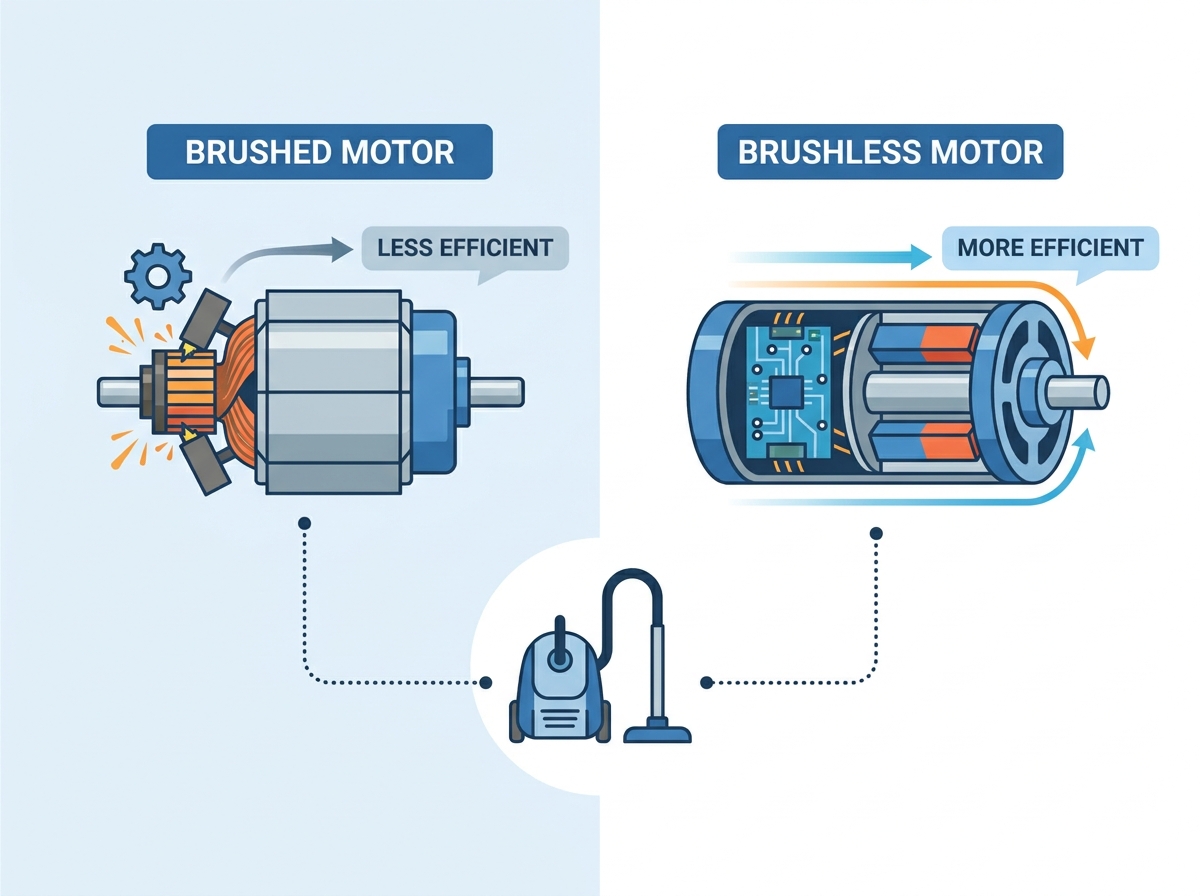
Comparing a brushed vs brushless vacuum motor requires analyzing critical performance metrics. These dimensions directly impact user experience, operational efficiency, and maintenance intervals on the floor.
Maximum RPM capabilities differ significantly between the two architectures. Brushless designs safely exceed 100,000 RPM because they lack physical friction points. Traditional motors are typically capped at much lower speeds (around 30,000 to 40,000 RPM) to prevent excessive heat buildup and rapid brush disintegration. The higher RPM of electronic motors allows engineers to design smaller, more aggressive impellers that generate massive suction in a compact footprint.
Energy conversion rates highlight a major performance gap. Brushless units hit 85-90% efficiency. Traditional motors lose 20-40% of their energy to heat and friction. For cordless models, this efficiency dictates battery draw. Higher efficiency equals longer runtimes at equivalent suction levels, making advanced motors indispensable for battery-operated devices. When running off a standard 18V or 20V tool battery, every watt saved from friction translates to more trigger time.
Performance Metric | Traditional Motor | Electronic Motor |
|---|---|---|
Maximum RPM | 30,000 - 40,000 | 100,000+ |
Energy Efficiency | 60% - 80% | 85% - 90% |
Heat Generation | High (Friction + Electrical) | Low (Electrical only) |
Suction-to-Weight Ratio | Moderate | Excellent |
Expected lifecycles contrast sharply. Carbon brushes have a predictable failure rate, usually requiring replacement after 500 to 1,000 hours of operation. Once the brushes wear down, the motor stops functioning. Brushless units offer an extended operational life, generally limited only by the physical degradation of the bearings or eventual electronic component failure. In a commercial setting running 8 hours a day, a traditional motor will need servicing within months, while the electronic counterpart will run for years.
Performance degradation also varies. Traditional motors lose efficiency gradually as the brushes wear down and the commutator pits. This wear increases electrical resistance and reduces suction power over time. Brushless systems maintain consistent performance throughout their lifespan until a definitive electronic or bearing failure occurs. You get the exact same suction on day 1,000 as you did on day one.
Noise generation profiles differ based on mechanical construction. Traditional motors produce mechanical friction noise from the brushes and distinct electrical arcing sounds. Brushless models eliminate this friction noise entirely. However, the rapid switching of the ESC can introduce a high-frequency electronic whine that some users find noticeable. Sound dampening materials in the vacuum housing must be tuned differently depending on the motor type used.
Heat dissipation requirements dictate sustained performance. Frictionless designs run cooler, reducing the need for aggressive thermal throttling during sustained vacuuming tasks. Traditional motors generate substantial heat, which can trigger thermal overload switches if airflow becomes restricted by a full bag or clogged filter. On a job site, a clogged filter on a traditional flow-through motor will cause it to overheat and shut down within minutes.
The power-to-weight ratio heavily favors modern electronic designs. The absence of physical commutators and heavy brush assemblies allows brushless units to be significantly more compact. This miniaturization enables modern, lightweight stick vacuum designs that deliver high suction without causing user fatigue. When designing backpack vacuums for commercial cleaning crews, saving two pounds on the motor assembly drastically reduces operator strain over a full shift.
Financial implications influence the selection of motor technology. Buyers must weigh initial expenses against long-term operational value and maintenance downtime.
Manufacturing economics favor traditional designs. They are mechanically simple, rely on standard raw materials like copper and iron, and are cheap to produce at scale. This keeps the initial purchase price of the vacuum cleaner low. For a shop vac that gets used once a month to clean out a garage, this low initial cost makes perfect sense.
Brushless technology carries a cost premium. This premium is driven by the use of rare-earth magnets and the complex PCB controllers required for electronic commutation. However, the higher upfront cost often pays for itself through extended lifespan, zero brush maintenance, and reduced energy consumption in high-frequency use cases. Commercial cleaning companies running machines daily quickly recoup the initial investment through eliminated maintenance downtime.
Maintenance realities differ drastically. Traditional motors often allow for cheap carbon brush replacements. Swapping out worn brushes can significantly extend the life of the machine for a minimal parts expense. A skilled technician can replace a set of brushes in under ten minutes, getting the machine back on the floor quickly.
Repairing brushless systems presents higher risks. When a failure occurs, it usually requires replacing the entire motor module or the expensive control board. Field-repairing complex PCBs is rarely viable, meaning a single electronic failure can result in a costly complete module replacement. You cannot simply solder a new component onto a conformal-coated ESC in the field.
Selecting the correct motor architecture depends entirely on the specific vacuuming application and environmental constraints. You must match the tool to the job.
Brushless technology is the non-negotiable standard for consumer cordless and robot vacuums. Strict battery constraints demand maximum electrical efficiency. Weight limits require compact form factors. Furthermore, high RPM requirements are necessary to drive the cyclonic separation systems found in modern stick vacuums. A traditional motor would drain the battery too quickly and add too much bulk to the handle.

The market for upright and canister vacuums remains mixed. Corded models still successfully utilize traditional motors. Unlimited AC power from a wall outlet negates the strict need for battery-saving energy efficiency. The lower manufacturing costs keep these units highly competitive for residential and commercial floor cleaning where weight is supported by wheels rather than the user's arm.

Heavy-duty industrial vacuums often utilize traditional by-pass motors. In these systems, the cooling air is separated entirely from the vacuumed air, protecting the motor from moisture and debris. When sucking up concrete dust or flooded basements, this separation is critical.
This highlights the industrial paradox. Industrial vacuum manufacturers still use traditional motors more than modern electronic variants. Traditional designs offer robust tolerance against harsh environmental particles, feature simpler electrical systems less prone to static damage, and provide cost-effective high torque for intermittent heavy-duty cycles. A simple copper and iron motor can take a beating on a construction site better than a delicate circuit board.
Supply chain factors and environmental conditions must influence motor selection for commercial and industrial procurement. You must look beyond the spec sheet and consider the operating environment.
Traditional motors emit fine carbon dust as the brushes wear down. This poses a severe contamination risk in cleanrooms, laboratories, or hospital environments. Using these motors in sensitive areas requires heavy HEPA filtration on the exhaust to capture the carbon particles before they enter the room air.
Conversely, brushless ESCs are vulnerable to environmental hazards. Moisture, static discharges, or fine conductive dust can easily short out the control board. If the electronics are not properly potted or sealed with conformal coating, the motor will fail prematurely in harsh industrial settings. Drywall dust, which is highly conductive when slightly damp, is notorious for destroying unprotected ESCs.
Modern electronic motors rely heavily on global semiconductor supply chains. The microchips required for the ESC are subject to electronic component shortages. Traditional motors rely on raw-material simplicity, primarily copper wire and iron stators, making their supply chains generally more stable and predictable. When chip shortages hit, manufacturers of traditional motors can continue production without interruption.
Choosing between a brushed vs brushless vacuum motor depends on your cleaning environment, usage frequency, performance expectations, and long-term maintenance costs. By comparing efficiency, durability, operating expenses, and application requirements, you can select the motor technology that delivers the best balance of performance, reliability, and overall value.
About SNDVAC
SNDVAC is a professional vacuum cleaner manufacturer specializing in cordless stick vacuums, upright vacuums, handheld vacuums, canister vacuums, and wet & dry cleaning equipment. With advanced motor technology, strong R&D capabilities, strict quality management, and flexible OEM/ODM services, SNDVAC develops high-performance vacuum cleaners that combine powerful suction, efficient filtration, energy-saving operation, and long-lasting reliability for customers worldwide.
Choose a brushless motor for cordless vacuums, higher efficiency, quieter operation, and longer service life.
Choose a brushed motor for cost-sensitive, corded, or heavy-duty industrial applications where simple maintenance is preferred.
Compare motor efficiency, maintenance requirements, expected lifespan, and operating costs before making your decision.
Select products from manufacturers that provide reliable motor technology, quality assurance, and comprehensive technical support.
Before purchasing a vacuum cleaner, evaluate motor type, suction performance, energy efficiency, durability, maintenance requirements, and overall product quality to choose the best solution for your application.
A: Traditional motors typically last between 500 and 1,000 hours before the carbon brushes wear out completely. Brushless models lack these physical wear points and can last thousands of hours. Their lifespan is generally limited only by the physical wear of the internal bearings or eventual electronic board failure.
A: Yes, replacing brushes is technically possible and historically common. However, many modern consumer vacuums feature sealed motor housings. This design choice prevents easy access to the brushes, often forcing users to replace the entire motor assembly or the vacuum cleaner itself when the brushes fail.
A: While they run cooler due to the absence of mechanical friction, they can still overheat. The electronic speed controllers generate heat during rapid switching. If the vacuum's airflow is severely restricted by clogged filters or a full dustbin, the lack of cooling air can cause the electronics to overheat and fail.
A: It is highly worth the extra cost for battery-operated devices like cordless stick vacuums or robot vacuums, where efficiency directly dictates runtime. For corded models used infrequently, the higher upfront cost may not provide enough operational return to justify the expense over a traditional motor.
A: Heavy-duty shop vacuums prioritize a high cost-to-torque ratio. Traditional motors are cheaper to manufacture for high-power applications. Additionally, they tolerate harsh, dusty environments well. Because shop vacuums run on unlimited corded power, the energy efficiency losses of traditional designs are less critical.
A: The motor itself does not generate suction; it spins the impeller. However, because it can sustain much higher RPMs efficiently without burning out, manufacturers can pair it with more aggressive impeller designs. This combination leads to significantly higher AirWatts and stronger overall suction performance.
A: These terms describe different aspects of the motor. Brushless refers to how the motor is electrically commutated without physical brushes. By-pass refers to the physical airflow routing, where a separate fan draws clean ambient air to cool the motor, keeping the vacuumed debris and moisture completely separate from the electrical components.


