
- All
- Product Name
- Product Keyword
- Product Model
- Product Summary
- Product Description
- Multi Field Search
Views: 0 Author: Site Editor Publish Time: 2026-07-24 Origin: Site


The transition from bulky, corded uprights to agile, battery-powered vacuums has fundamentally changed home maintenance, but it introduces a new dilemma in choosing the right form factor. Buyers frequently misjudge their primary cleaning needs, leading to the purchase of an underpowered stick vacuum for heavy-duty floor jobs or an overly expensive, top-heavy unit when a simple spot-cleaner was required. Resolving the stick vacuum vs handheld vacuum debate requires a realistic assessment of floor types, ergonomic tolerances, battery limitations, and the specific nature of household messes.
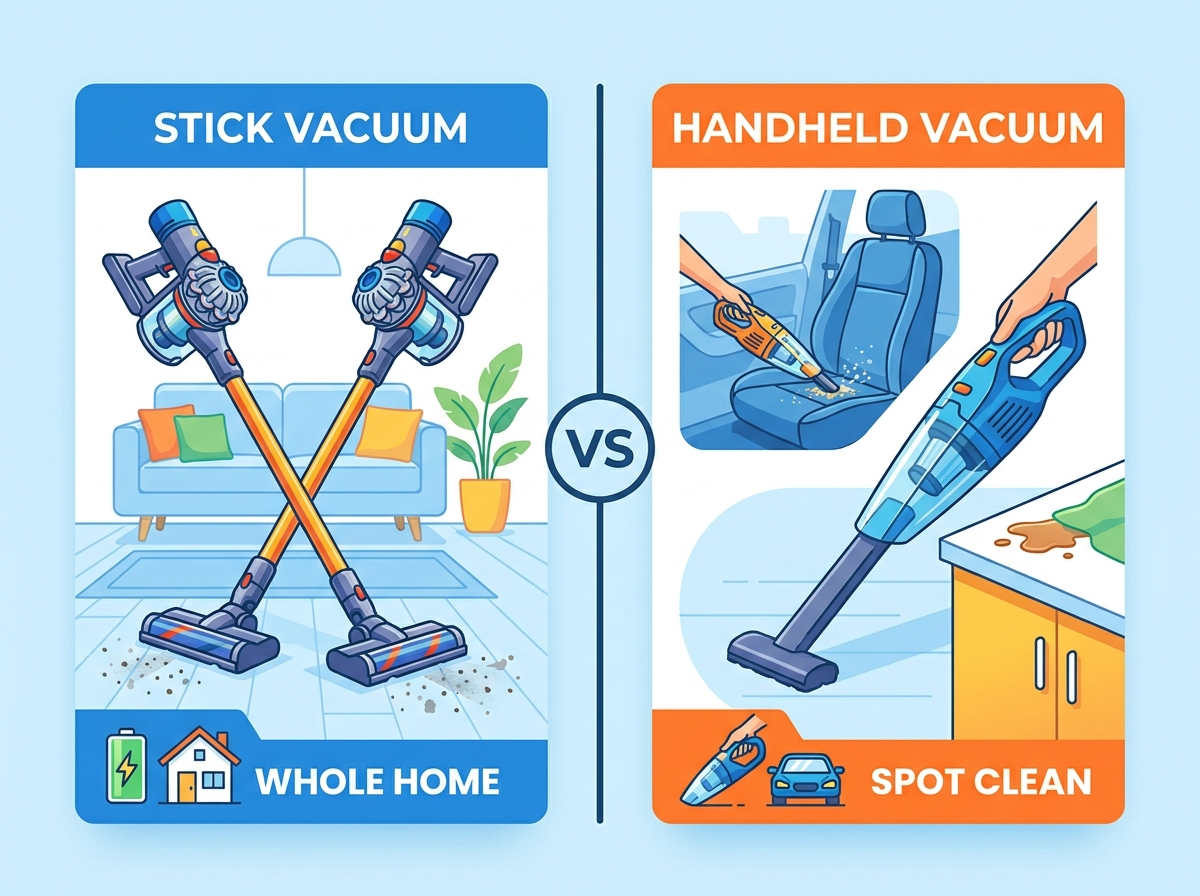
Versatility vs. Specialization: Stick vacuums offer floor-to-ceiling cleaning and often convert into handhelds, whereas dedicated handheld vacuums are strictly for above-floor, localized messes.
Ergonomics and Fatigue: Stick vacuums carry their motor and battery weight in the handle, which can cause significant wrist strain during extended or high-up use; handhelds are lighter and optimized for short, targeted bursts.
Cost-to-Value Ratio: High-end stick vacuums require a significant investment (often rivaling premium corded models), while dedicated handhelds remain highly budget-friendly secondary tools.
Battery Realities: Both options face strict runtime limits (typically 10 to 60 minutes), making battery ecosystem (integrated vs. swappable) a critical purchasing factor.
Table of Contents
Categorizing cleaning needs into distinct buckets simplifies the purchasing process. You must determine if you require whole-room maintenance, quick spill remediation, vehicle detailing, or dedicated pet hair removal. A single appliance rarely excels at all four tasks simultaneously. Identifying your primary use case prevents overspending on features you will never deploy on the job or at home.
Setting realistic performance expectations prevents frustration. Cordless vacuums generally offer lower sustained suction than corded uprights or heavy-duty canisters. They function best for daily surface maintenance rather than deep carpet extraction. Relying on a battery-powered motor to pull years of embedded dirt from high-pile carpets often leads to overheating and rapid battery drain. You need to match the tool to the specific site conditions.
Assessing your available storage and charging infrastructure is equally critical. Wall-mounted charging docks require dedicated wall space near an electrical outlet. You also need a footprint for storing multiple attachments, wands, and motorized brush heads. If you live in a compact apartment without drillable wall space, a freestanding unit or a compact handheld might better suit your spatial constraints.
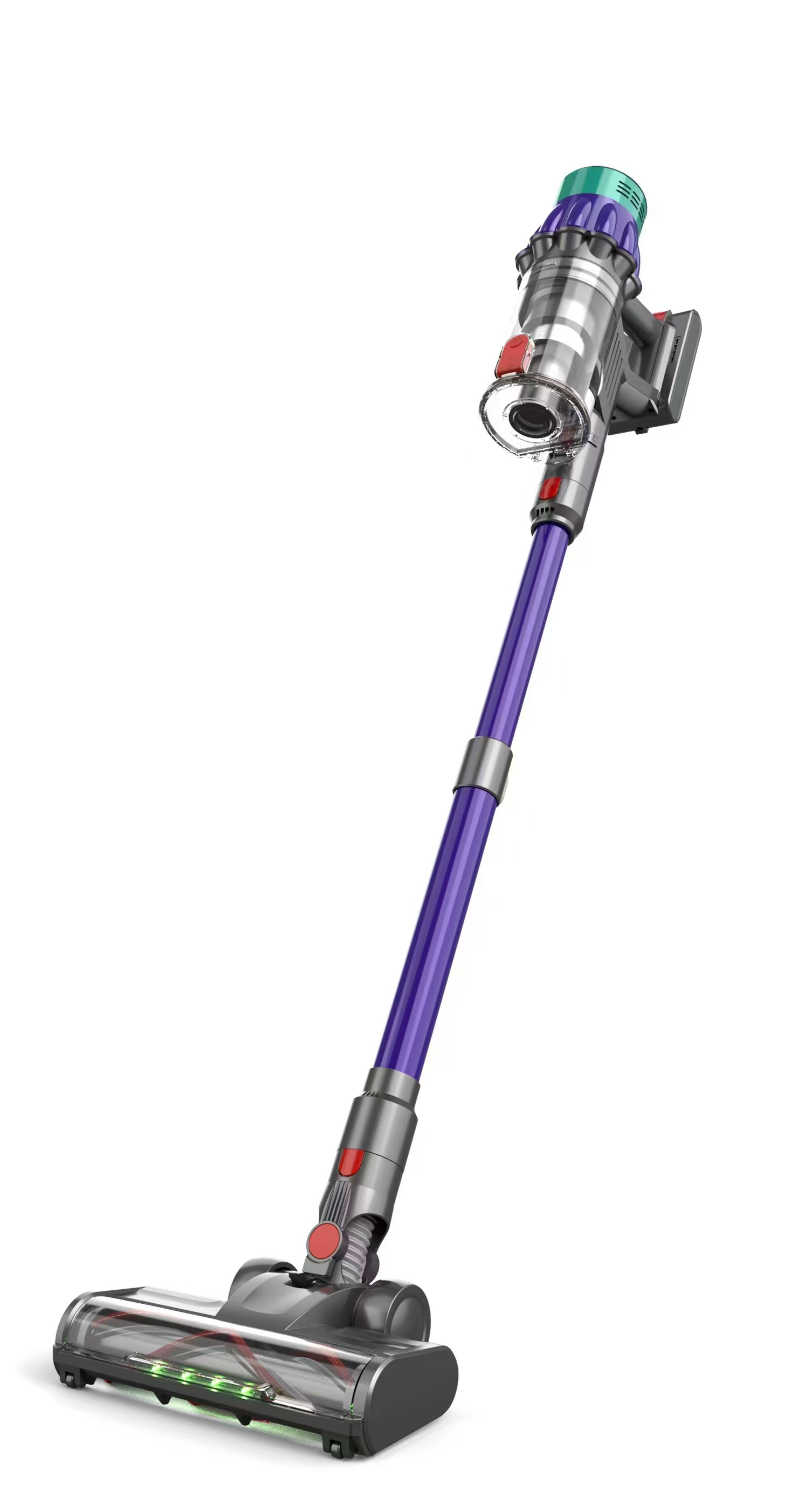
A stick vacuum utilizes specialized cleaning heads to agitate carpets or capture large debris on hard floors. Motorized brush rolls dig into carpet fibers to lift hair and dander. Soft rollers excel on hard surfaces like hardwood or tile, grabbing fine dust without scratching the finish or scattering larger crumbs across the room. Field tests show that using the wrong roller on hard floors simply kicks debris around rather than extracting it.
The rigid extension wand provides significant reach and coverage advantages. You can clean under low-clearance furniture, reach ceiling corners for cobwebs, and cover large square footage without bending over. This upright posture reduces lower back strain during whole-house cleaning sessions, a major factor for anyone doing daily maintenance.
Modern convenience upgrades have transformed these devices. Many now feature auto-empty stations that pull debris from the dustbin into a sealed bag, minimizing dust exposure. Integrated dirt-detection sensors, utilizing lasers or LEDs on the floor head, reveal microscopic dust particles that remain invisible under normal room lighting.
Most modern stick vacuums feature a highly modular design. Users can easily remove the main extension wand and attach specialized tools directly to the motor unit. This effectively transforms the floor cleaner into a convertible handheld device for stairs, upholstery, or car interiors.
Consolidating your cleaning arsenal offers distinct benefits. Purchasing one versatile appliance to handle both extensive floor care and localized dusting saves closet space. You only need to maintain one battery ecosystem and empty one primary dustbin.
Top-heavy ergonomics represent a major drawback. The heaviest components, including the battery, motor, and dustbin, rest directly in your hand. This weight distribution causes significant wrist and forearm strain during extended use, particularly when maneuvering the device overhead to clean curtains or ceiling fans.
Restricted bin capacity necessitates frequent emptying. The slim profile requires a smaller dustbin compared to traditional uprights. If you have multiple shedding pets, you may need to pause and empty the bin several times during a single cleaning session.
Targeted spot cleaning defines the primary utility of a handheld vacuum. These compact units excel at clearing kitchen counters, refreshing upholstery, navigating carpeted stairs, and detailing tight automotive interiors where a full-sized wand cannot fit.
Instant deployment makes them indispensable for busy households. You can grab a lightweight tool for immediate spill remediation without assembling wands or swapping large floor heads. This rapid response time prevents dry spills from being ground into carpets or tracked across hard floors.
Dedicated handhelds balance weight far more effectively than a converted stick vacuum. The motor and battery sit closer to the center of gravity. This balanced weight distribution drastically reduces wrist fatigue during intricate tasks like vacuuming car floorboards or cleaning between couch cushions.
A compact footprint allows for highly flexible storage. You can easily store the unit in small kitchen cabinets, desk drawers, or directly in a vehicle trunk. They require minimal space and do not demand complex wall-mounting hardware.
Zero floor utility remains the most significant limitation. You cannot clean hard floors or carpets without severe physical discomfort. Attempting to clean a whole room on your hands and knees is highly inefficient and physically taxing.
Feature stripping frequently occurs in this category. Basic handheld models often lack high-efficiency particulate air (HEPA) filtration, motorized pet tools, or multi-cyclonic separation. This can result in fine dust blowing back into your breathing zone during operation.

Evaluating standard suction metrics requires looking at Air Watts (AW). A stick vacuum generally features a larger, more robust motor. These units often exceed 100 AW on their maximum boost modes. A standard handheld vacuum typically produces significantly lower suction, relying more on agitation from attachments than raw airflow.
Filtration standards dictate indoor air quality. Sealed HEPA systems in stick vacuums prevent fine dust and allergen recirculation. This critical feature is frequently omitted in basic handheld models, making them unsuitable for severe allergy sufferers dealing with fine particulate matter.
Runtime realities rarely match marketing claims. Advertised runtimes often reflect the lowest suction setting without motorized tools attached. Realistic high-power usage, especially on thick carpets with a motorized brush roll, can drain a battery in under ten minutes.
Choosing models with swappable batteries provides a distinct long-term advantage. Removable batteries allow you to double your runtime by keeping a spare on the charger. More importantly, it prevents the entire device from becoming electronic waste when the lithium-ion cells inevitably degrade after a few years of use.
Stick vacuum tool suites generally offer comprehensive solutions. Standard inclusions feature crevice tools, dusting brushes, mini-motorized pet hair tools, and interchangeable soft rollers for hard floors. This variety ensures you have the exact tool needed for diverse surfaces.
Handheld tool suites often rely on built-in flip-up brushes or basic loose attachments. Assessing the necessity of motorized tools is vital. Static suction alone struggles to pull embedded pet hair from fabric upholstery; a motorized mini-brush is practically mandatory for pet owners.
Handle weight and overhead maneuverability dictate user comfort. Awkward weight distribution in stick vacuums causes fatigue when lifting the unit to clean high shelves. Conversely, the compact, lightweight chassis of a dedicated handheld allows for effortless maneuvering in tight spaces without straining the wrist or shoulder.
Feature | Stick Vacuum | Handheld Vacuum |
|---|---|---|
Primary Use Case | Whole-room floors, carpets, and high reach. | Spot cleaning, cars, counters, stairs. |
Ergonomics | Top-heavy; can cause wrist strain overhead. | Lightweight, balanced, easy to maneuver. |
Storage Needs | Requires wall mount or tall closet space. | Fits in drawers, cabinets, or car trunks. |
Filtration | Often includes sealed HEPA systems. | Rarely includes true HEPA filtration. |
Floor Capability | Excellent; includes motorized floor heads. | Poor; requires kneeling and lacks floor heads. |
Analyzing upfront cost versus long-term utility drives the purchasing decision. You must decide whether it makes sense to buy a premium all-in-one device or pair a traditional corded upright with a basic handheld for quick messes. The combo approach often yields better deep-cleaning results on carpets while maintaining convenience for small spills.
Evaluating corded stick vacuums provides a reliable alternative. These units avoid battery degradation entirely and offer unlimited runtime. However, you must balance this reliability against the loss of cordless mobility and the hassle of managing a power cord around furniture legs.
Comparing the utility of an automated robot vacuum paired with a handheld vacuum presents another viable strategy. The robot handles daily floor maintenance automatically, while the handheld tackles stairs and upholstery. This combination drastically reduces manual labor compared to owning a single, manual stick vacuum.
Maintenance overhead demands consideration. You must account for the time cost of washing pre-motor filters, untangling hair from brush rolls, and clearing clogs in narrower extension wands. Neglecting these tasks rapidly degrades suction performance and motor lifespan.
Acknowledging durability and lifespan is essential. Battery-operated vacuums generally have a shorter operational lifespan than corded counterparts. Lithium-ion degradation and complex electronic failure points mean these devices often require replacement sooner than traditional plug-in models.

Premature battery death ruins the cordless experience. Extreme temperatures degrade lithium-ion cells rapidly. Avoid storing your vacuum in uninsulated garages or hot car trunks. Opt for brands that actively sell OEM replacement batteries to ensure you can swap out a dead cell rather than replacing the entire machine.
Loss of suction over time usually stems from poor maintenance. Dust accumulation blocks airflow through the cyclonic separators and filters. Establish a strict routine for washing pre-motor filters and replacing HEPA filters exactly according to the manufacturer guidelines. Check the wand and floor head regularly for hidden blockages.
Inadequate pet hair removal frustrates many buyers. Static suction simply glides over hair woven into fabric fibers. Ensure the chosen model explicitly includes a motorized mini-brush attachment. The physical agitation of the spinning bristles is required to pull embedded hair from couches, car seats, and carpeted stairs.
Choosing between a stick vacuum vs handheld vacuum depends on your cleaning habits, home layout, and the types of surfaces you clean most often. By comparing portability, suction performance, battery life, versatility, and long-term maintenance, you can select the cordless vacuum that best matches your daily cleaning needs and delivers the best overall value.
About SNDVAC
SNDVAC is a professional vacuum cleaner manufacturer specializing in cordless stick vacuums, handheld vacuums, upright vacuums, canister vacuums, and wet & dry vacuum cleaners. Backed by advanced R&D, modern manufacturing facilities, strict quality control, and flexible OEM/ODM services, SNDVAC provides innovative cleaning solutions designed for residential, commercial, and industrial applications worldwide.
Choose a stick vacuum for whole-home floor cleaning, carpets, hard floors, and versatile floor-to-ceiling cleaning.
Choose a handheld vacuum for quick cleanups, car interiors, upholstery, stairs, and localized messes.
Compare battery runtime, suction power, attachments, filtration, and ergonomics before making your decision.
Select vacuum cleaners from manufacturers with proven engineering expertise, reliable quality, and comprehensive after-sales support.
Before purchasing a cordless vacuum cleaner, evaluate your cleaning environment, storage space, battery requirements, surface types, and long-term maintenance needs to choose the solution that best fits your lifestyle.
A: It depends on your home. For small apartments with hard floors or low-pile rugs, a high-quality stick vacuum can serve as the sole cleaner. For large homes with thick, high-pile carpets, they generally lack the sustained suction and battery life required for deep extraction, making an upright necessary.
A: Yes, but only if equipped correctly. A handheld vacuum relying solely on static suction will struggle. You must choose a model that includes a motorized mini-brush attachment. The spinning bristles agitate the fabric, pulling embedded pet hair out of upholstery and car seats effectively.
A: Real-world runtime varies drastically by power setting. While manufacturers often advertise 40 to 60 minutes, this is usually on the lowest suction setting without a motorized tool. On maximum boost mode with a spinning floor head, expect the battery to deplete in 10 to 15 minutes.
A: A separate upright and handheld combo often provides better deep cleaning for carpets and avoids battery degradation issues for the main floor cleaner. However, a 2-in-1 stick vacuum offers superior convenience, saves storage space, and is much easier to maneuver for daily surface maintenance.
A: Most modern cordless vacuums use lithium-ion batteries designed to provide fade-free power. This means the suction remains consistent until the battery is completely depleted, at which point the machine will shut off abruptly rather than slowly losing power.
A: Store the vacuum indoors in a climate-controlled environment. Avoid extreme heat or cold, which degrades lithium-ion cells. Use the manufacturer-provided wall dock for safe storage. If your model has a removable battery, consider keeping it on a dedicated charging base on a countertop.
A: Yes. Corded stick vacuums eliminate the battery entirely. This removes the most common point of failure (lithium-ion degradation) and provides unlimited runtime. However, you sacrifice the primary benefit of cordless mobility and must manage a power cable during use.


