
- All
- Product Name
- Product Keyword
- Product Model
- Product Summary
- Product Description
- Multi Field Search
Views: 0 Author: Site Editor Publish Time: 2026-07-24 Origin: Site


When shopping for floor care equipment, buyers constantly hit a wall of conflicting technical specifications. Manufacturers market their machines using a chaotic mix of non-standardized metrics, throwing around Watts, Amps, Pascals, and Air Watts to make their products sound superior. This intentional misdirection creates massive buyer confusion. Without knowing how to read these numbers, you end up guessing whether a machine will actually pull dirt out of your carpet or just make a loud noise while pushing dust around.
Buying a machine based on raw motor wattage usually means you spend money on an inefficient unit that wastes electricity. On the flip side, underestimating the suction you actually need leaves heavy debris and allergens trapped deep in your flooring, forcing you to replace the unit prematurely. Electrical input does not equal dirt removal. You need a reliable technical framework to evaluate true vacuum cleaner suction power.
This guide breaks down the engineering specifications into real-world cleaning capabilities. By matching specific flooring types and household demands to the correct performance metrics, you can select a vacuum cleaner that handles your exact workload without overpaying for useless specs.

Motor Wattage ≠ Suction: Electrical input (Watts/Amps) measures how much power the machine consumes, not how much dirt it removes.
Air Watts (AW) and CFM Rule: Air Watts and Cubic Feet per Minute (CFM) are the most accurate, standardized indicators of a vacuum's actual cleaning efficiency.
Surface-Specific Thresholds: Hard floors require significantly less suction (approx. 80–100 AW) compared to high-pile carpets or pet-heavy households (200+ AW).
Sealed vs. Working Suction: Standardized testing (like ASTM F558) distinguishes between sealed suction (static pressure) and working suction (airflow under load), both of which dictate real-world performance.
System Design Impacts Output: A vacuum cleaner with high raw suction power can still perform poorly if it lacks proper brush roll agitation, an airtight seal, or efficient cyclonic filtration.
Table of Contents
Understanding the numbers on the box requires separating the marketing hype from the actual physics of airflow and static pressure. Different metrics measure entirely different parts of the system.
Manufacturers plaster high wattage numbers on the box because a 1,200-watt motor sounds twice as strong as a 600-watt motor. This is an illusion. Wattage and amperage only tell you how much electricity the motor pulls from your wall outlet. They tell you absolutely nothing about how much dirt the machine will pick up.
High wattage often points to an inefficient motor design. A poorly engineered motor will draw massive amounts of power but lose most of it to heat, friction, and noise. You end up with a machine that trips your circuit breakers and runs hot, but still leaves pet hair on the rug. Relying on motor power as your primary metric guarantees you are evaluating electrical consumption rather than cleaning output.
Air Watts (AW) is the gold standard for measuring actual cleaning capability. This metric calculates the relationship between airflow (CFM) and water lift (suction) right at the cleaner head. It represents the usable power available to lift debris off the floor and carry it into the dustbin.
AW accounts for the efficiency of the entire system. It factors in the motor's output, the aerodynamics of the internal piping, and the resistance created by the filters. When you compare an upright or stick model, AW gives you a direct, apples-to-apples comparison of performance. A unit pushing 150 AW will consistently out-clean a 100 AW unit, provided their floor heads are designed similarly.
Pascals (Pa) measure sealed suction. This tells you how much static pressure the motor generates when the airflow is completely blocked off. It is a measurement of raw lifting force. If you need to pull a heavy object straight up, Pa is the metric that matters.
You will see Pa used almost exclusively in the robot and cordless stick markets. Because these units are small, manufacturers use Pa to highlight their lifting capability. Keep the conversion in mind: 1 kPa equals 1,000 Pa. A spec sheet listing 25,000 Pa is exactly the same as 25 kPa. While high static pressure is great for pulling dirt out of tight crevices, it fails to clean effectively if the machine lacks the airflow to move that dirt into the bin.
Cubic Feet per Minute (CFM) measures the volume of air moving through the system. If Pa is the strength to lift the dirt, CFM is the river that carries it away. You need high CFM to move large volumes of debris, like spilled cereal, wood chips, or heavy sand, from the floor head, up the hose, and into the dirt chamber.
A machine with massive sealed suction (Pa) but terrible airflow (CFM) will clog constantly. The dirt gets lifted to the nozzle but doesn't have the velocity to travel up the tube. Balancing static pressure with high CFM is the only way to achieve comprehensive, clog-free cleaning.

To stop manufacturers from making up their own numbers, laboratories use standardized test methods like ASTM F558. This standard dictates exactly how airflow and static pressure must be measured to calculate Air Watts. It levels the playing field.
The critical distinction in ASTM F558 is where the measurement takes place. Measuring suction directly at the motor intake yields a massive number, but it ignores the suction lost as air travels through the hose, wands, and filters. The standard requires measuring usable suction at the end of the cleaning hose or floor nozzle. This is the only measurement that reflects what you will actually experience on your floors.
Metric | What It Measures | Best Used For Evaluating |
|---|---|---|
Watts (W) / Amps (A) | Electrical power consumed by the motor. | Energy efficiency and circuit load, not cleaning power. |
Air Watts (AW) | Overall cleaning efficiency (Airflow x Water Lift). | Upright, canister, and stick models. |
Pascals (Pa) | Sealed suction / static pressure. | Robot models and crevice extraction. |
CFM | Volume of air moving through the system. | Shop vacs and large debris pickup. |
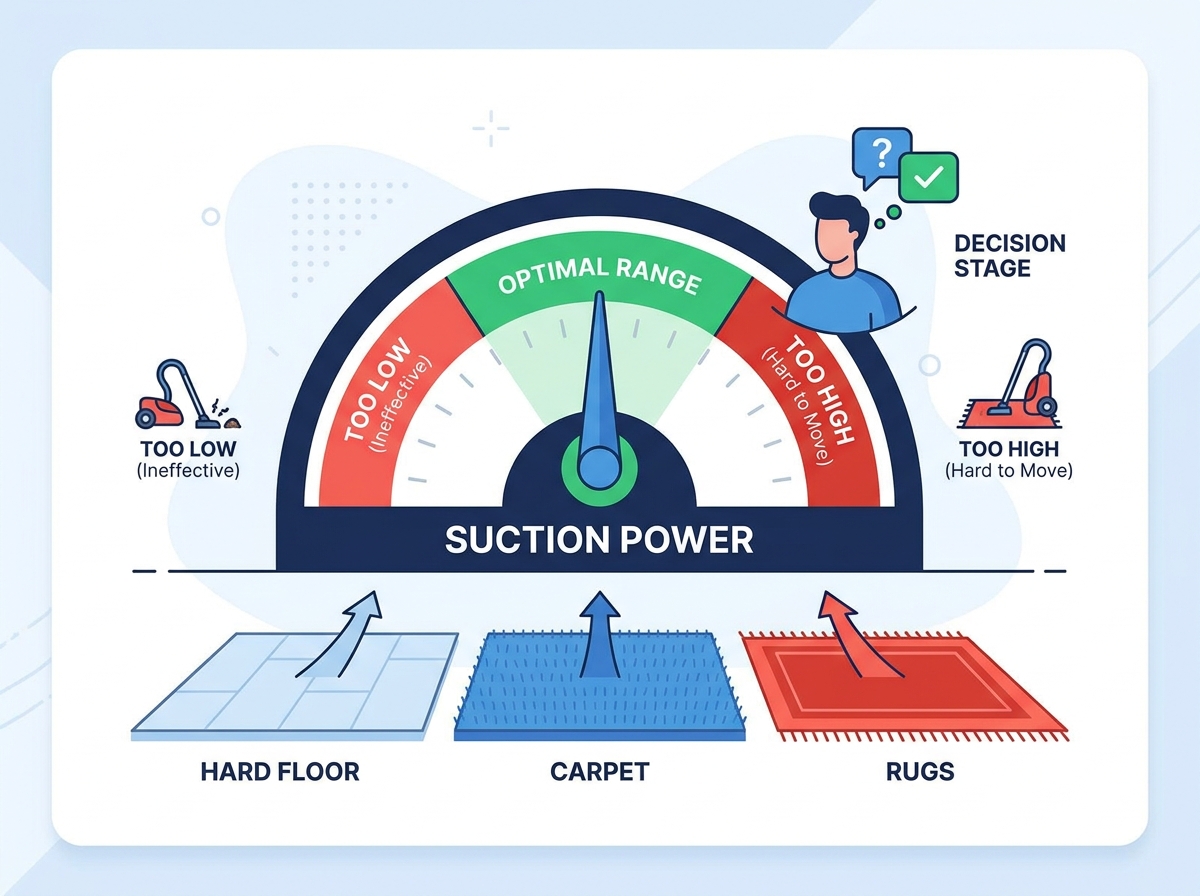
Different floors require entirely different mechanical approaches. Throwing maximum power at every surface is inefficient and often makes the machine impossible to push.
Hard floors are the easiest surfaces to clean. The goal is to remove surface dust and pull debris out of grout lines without scattering it across the room. Because dirt sits on top of the surface rather than getting tangled in fibers, you need significantly less raw power.
A baseline of 80 to 100 AW (or 1,500 to 2,000 Pa for robotic units) is more than enough. On hard floors, the design of the floor head matters more than the motor. A soft roller brush creates a seal against the floor and physically wipes fine dust away, outperforming a 300 AW machine equipped with a standard bristled brush that just kicks the dirt around.
Low-pile carpets and area rugs require a balance. You need enough power to pull dirt from the shallow fibers, but if the suction is too high, the floor head will suck down onto the rug, making it impossible to move or lifting the rug entirely off the floor.
Aim for a baseline of 100 to 150 AW (or 12 to 15 kPa). This provides the necessary airflow to extract settled dust without creating a vacuum seal against the backing of the rug. Adjustable suction controls are highly recommended for homes with multiple area rugs.
Thick, plush carpets are the ultimate test of a machine's capability. Dirt, silica sand, and allergens sink past the fibers and settle directly against the carpet backing. Removing this embedded debris requires aggressive mechanical agitation combined with massive airflow.
You need a minimum of 200+ AW (or 20+ kPa) for high-pile carpets. The machine must generate enough velocity to pull heavy particles up through an inch of dense fiber. Anything less will only groom the top layer of the carpet, leaving the abrasive sand at the bottom to slowly destroy the carpet fibers over time.
Pet hair weaves itself into fabrics and carpet fibers, creating a strong static bond. Suction alone will not remove it. You have to break the physical bond first.
The requirement here is a minimum of 200 AW paired specifically with a motorized, tangle-free brush roll. The stiff bristles of the brush roll dig into the carpet to rip the hair loose, while the high AW provides the airflow to instantly pull the hair into the bin before it can settle back down.
Cleaning vehicles and stairs means dealing with tight crevices, narrow gaps, and stubborn dirt ground into floor mats. Wide floor heads are useless here. You need concentrated power.
A baseline of 120 to 150 AW is required. By forcing this airflow through a narrow crevice tool, you exponentially increase the air velocity and static pressure at the tip. This high-velocity configuration is what allows you to rip dried mud out of car upholstery and pull crumbs from between sofa cushions.
The form factor of the machine dictates its physical limitations. You cannot expect a battery-powered stick to match the sustained output of a corded upright.
Corded uprights and canisters are the heavy-duty workhorses of floor care. Because they plug directly into the wall, they are not constrained by battery weight or voltage limits. Manufacturers can install massive motors and complex, multi-stage filtration systems.
These units consistently deliver 250 to 300+ AW and push well over 100 CFM. They provide relentless, sustained power. If you have a large home with extensive wall-to-wall carpeting, this is the only category that will provide the deep extraction required without forcing you to stop and recharge.
Cordless sticks are an exercise in compromise. Engineers must constantly balance battery voltage, motor weight, and run-time against peak performance. To keep the machine light enough to hold with one hand, the motors and batteries must remain small.
While high-end sticks advertise impressive "Max" modes hitting 150 to 240 AW, this is highly deceptive. Running the machine on Max mode will drain the battery in 5 to 10 minutes and often causes the battery to overheat, triggering thermal throttling. To get the advertised 40-minute run-time, you have to use the Eco mode, which drops the output to a meager 30 to 50 AW. This is fine for daily hard floor dusting, but completely inadequate for deep carpet cleaning.
Robotic units are built for daily maintenance, not deep extraction. Their flat, compact design leaves very little room for a motor, and the small battery has to power the drive wheels, the navigation sensors, and the suction motor simultaneously.
Because they cannot generate high CFM, robots rely on static pressure (Pa) and mechanical sweeping. A standard robot pulls between 2,000 and 8,000+ Pa. The side brushes sweep debris directly under the machine, and the main roller kicks it up into the narrow suction path. The Pa is just strong enough to lift the dirt the final inch into the dustbin.

Shop vacs are built for the garage and the job site. They do not use motorized brush rolls or HEPA filters. Their sole purpose is to move massive amounts of heavy debris, water, and construction dust as quickly as possible without clogging.
In this category, AW is rarely used. Performance is measured in CFM (often exceeding 120) and Sealed Water Lift (measured in inches). A high water lift rating means the motor has the static pressure to pull heavy liquids up a long hose, while the massive CFM ensures large debris like screws and wood chunks fly into the drum without getting stuck.
A machine might pull 250 AW out of the box, but real-world conditions will quickly degrade that performance if the system is poorly designed or improperly maintained.
True HEPA filters are incredibly dense. They have to be, in order to trap microscopic allergens. However, pushing air through a dense filter requires a massive amount of force. If the motor is weak, the HEPA filter acts like a wall, choking off the airflow and killing the suction at the floor head.
As you use the machine, the filter loads up with fine dust, increasing the restriction. If you do not wash or replace the pre-motor and HEPA filters regularly, the airflow will drop to near zero, causing the motor to overheat and potentially burn out.
In cheap bagless models, the dirt goes straight into the bin and immediately clogs the primary filter. As the bin fills up, the suction drops off a cliff. You might start with 150 AW, but by the time the bin is half full, you are operating at 50 AW.
High-end models use multi-cyclonic separation. These systems spin the incoming air at extreme speeds, using centrifugal force to throw the fine dust out of the airstream and into the bin before the air ever reaches the filter. This keeps the filter clean and ensures the CFM remains constant from an empty bin to a full bin.
Raw suction is useless on carpets without mechanical agitation. A machine pulling 100 AW with an aggressive, stiff-bristled brush roll will extract more embedded dirt than a 300 AW machine with no brush roll.
The bristles physically separate the carpet fibers and beat the dirt loose. Once the dirt is airborne inside the floor head housing, the suction takes over and carries it away. If the belt breaks or the brush roll gets jammed with hair, your cleaning efficiency drops by 80%, regardless of how powerful the motor is.
Airflow is lazy; it will always take the path of least resistance. Every joint, connection, and wand extension is a potential leak. If the seals around your hose connections are worn out, the motor will pull air from the room rather than from the floor head.
Furthermore, long corrugated hoses create massive internal turbulence. The air crashes against the ridges inside the hose, slowing down the velocity. A 10-foot hose will deliver significantly less usable power to the attachment tip than a 3-foot hose.
Lithium-ion batteries degrade over time. After two or three years of heavy use, the internal resistance of the battery increases. It can no longer deliver the peak voltage required to spin the motor at maximum RPM.
This means your three-year-old cordless stick physically cannot produce the Air Watts it did when it was new. Additionally, even during a single cleaning session, the voltage sags as the battery drains. The machine will pull slightly less dirt at 10% battery than it does at 100% battery.
Stop looking at the highest numbers on the box and start evaluating your actual physical environment. Match the equipment to the job.
You must audit your floor plan before buying. Calculate the ratio of hard floors to carpets. Note the pile height of your rugs. Factor in the type of debris you deal with daily—fine dust, heavy mud, or excessive pet hair.
If your home is 80% hard floors, prioritize a lightweight unit with a soft roller head and 100 AW.
If your home is 80% thick carpet, demand a corded unit with a minimum of 200 AW and a motorized brush head.
If you have multiple pets, prioritize cyclonic separation and tangle-free brush designs over raw static pressure.
You pay a massive premium for battery technology. A $400 cordless stick might deliver 150 AW for ten minutes. A $150 corded upright will deliver 250 AW all day long. You have to decide if the convenience of losing the cord is worth the drastic reduction in sustained power and the higher upfront cost.
Motors that generate high static pressure run incredibly hot. Heat destroys bearings and electrical components. Look for machines with built-in thermal overload switches that shut the motor down before it melts during a clog.
Check the warranty length specifically for the motor. Also, investigate the maintenance requirements. A machine with washable lifetime filters will save you hundreds of dollars over five years compared to a unit that requires proprietary HEPA filter replacements every three months.
Choosing the right vacuum cleaner suction power is about more than selecting the highest specification on the product label. By understanding how Air Watts, airflow, suction pressure, filtration, and brush design work together, you can select a vacuum cleaner that delivers efficient, reliable, and long-lasting cleaning performance for your specific environment.
About SNDVAC
SNDVAC is a professional vacuum cleaner manufacturer specializing in cordless, upright, handheld, canister, and wet & dry vacuum cleaners. With advanced R&D capabilities, modern production facilities, strict quality management, and flexible OEM/ODM services, SNDVAC provides innovative cleaning solutions that combine powerful suction, reliable durability, and user-focused design for customers around the world.
Compare Air Watts, CFM, and suction pressure together instead of focusing on a single specification.
Choose suction performance based on your flooring type, cleaning frequency, and household needs.
Maintain filters, brush rolls, and airflow channels regularly to preserve long-term cleaning efficiency.
Work with manufacturers that provide transparent performance testing, quality assurance, and reliable after-sales support.
Before purchasing a vacuum cleaner, evaluate suction efficiency, airflow, filtration performance, brush roll design, runtime, and overall product quality to ensure the best cleaning performance and long-term value.
A: Hard floors require 80 to 100 Air Watts (AW). Low-pile carpets need 100 to 150 AW. High-pile carpets and homes with pets demand a minimum of 200 AW to extract embedded dirt and hair effectively.
A: No. Wattage measures electrical consumption, not dirt removal. A high-wattage motor is often just inefficient, converting electricity into heat and noise rather than usable airflow. Always evaluate performance using Air Watts (AW) or CFM.
A: For robotic units, anything above 4,000 Pa is considered strong and capable of handling low-pile carpets. Basic models pull around 2,000 Pa, which is only adequate for daily dust maintenance on hard floors.
A: Regular Watts measure the electricity entering the motor from the wall. Air Watts (AW) measure the actual cleaning force at the floor head, calculated by multiplying airflow (CFM) by static pressure (water lift). AW proves actual performance.
A: Sealed suction measures the maximum lifting force when the hose is completely blocked. Working suction (CFM) measures the volume of air moving through the open system. You need high CFM to carry the dirt into the bin.
A: Sudden power loss indicates a physical airflow restriction. This is usually caused by a clog in the hose, a jammed brush roll, a completely full dustbin, or severely compacted pre-motor filters blocking the air path.


