
- All
- Product Name
- Product Keyword
- Product Model
- Product Summary
- Product Description
- Multi Field Search
Views: 0 Author: Site Editor Publish Time: 2026-07-24 Origin: Site


The vacuum cleaner industry relies heavily on marketing terminology that obscures actual mechanical processes. A major point of confusion is treating cyclonic separation and HEPA filtration as competing technologies. They are entirely distinct mechanical processes solving different airflow problems. Comparing a cyclone vs HEPA vacuum means comparing a bulk debris management system to a terminal air purification standard. Selecting equipment based on misunderstood filtration specs leads to operational failures. You will experience degraded suction, premature motor failure, or the dangerous recirculation of microscopic allergens and hazardous particulates back into your breathing zone. We need a strict technical framework for evaluating both technologies. This guide examines particulate size limitations, airflow mechanics, maintenance realities, and how to determine the exact filtration architecture required to meet specific environmental standards without compromising suction power or hardware longevity.
Distinct Functions: Cyclonic technology separates large debris via centrifugal force to maintain suction, while HEPA is a terminal filtration standard designed to trap microscopic particles.
The Sealed System Mandate: A HEPA vacuum is only effective if the entire chassis is hermetically sealed; otherwise, micro-dust bypasses the filter and exhausts back into the air.
Performance vs. Retention: Pure cyclonic systems excel at constant airflow and heavy debris management, whereas HEPA systems prioritize absolute air purity and allergen containment.
Table of Contents
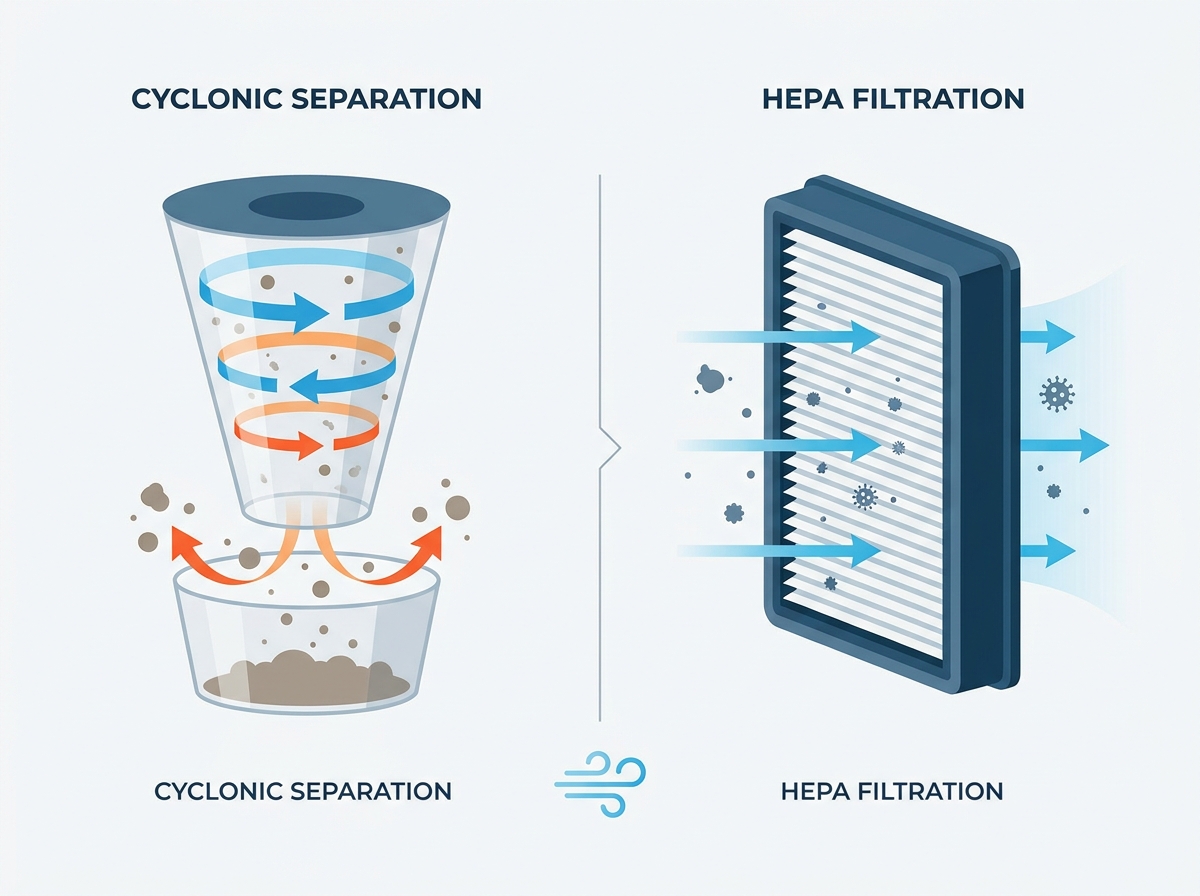
Cyclonic separation relies on the physics of high-speed centrifugal force to manage debris. As dirty air enters the vacuum canister, it is forced into a high-velocity spiral path. The heavier dust particles and large debris possess greater inertia than the air molecules. As the airstream spins, this inertia forces the particulate matter outward against the walls of the collection bin, where gravity eventually pulls it down out of the active airflow. This process happens continuously as long as the motor generates sufficient cubic feet per minute (CFM) of airflow.
The primary engineering goal of a cyclone is to prevent large particulates from ever reaching the pre-motor filters. By removing the bulk of the physical mass from the air before it passes through any porous media, the system maintains a clear air path. This prevents the rapid clogging that typically chokes suction power in traditional filter-in-bin designs. On active job sites dealing with wood shavings, drywall chunks, or heavy gravel, this pre-separation is mandatory to keep the equipment running without constant interruptions.
However, cyclonic separation has strict limitations based on particle mass. A cyclone alone cannot capture ultra-fine dust, biological aerosols, or microscopic allergens. These sub-micron particles lack the mass required to be thrown out of the airstream by centrifugal force. Consequently, they remain suspended in the air, passing straight through the cyclone and requiring secondary physical filters to prevent them from exhausting back into the environment.
Air enters the cylindrical chamber at a tangent, creating a vortex.
Centrifugal force pushes heavy debris against the outer walls.
Friction and gravity cause the heavy debris to fall into the collection hopper.
The inner, cleaner vortex of air travels upward through the center of the cyclone toward the motor.
High-Efficiency Particulate Air (HEPA) is not a specific brand or material, but a strict regulatory standard. To qualify as true HEPA, the filter media must capture a minimum of 99.97% of airborne particles sized exactly 0.3 microns. This specific particle size is used for testing because it represents the most penetrating particle size (MPPS)—the hardest size to trap. Particles both larger and smaller than 0.3 microns are captured at an even higher efficiency rate.
A HEPA vacuum utilizes a dense mat of randomly arranged fiberglass fibers to achieve this standard. Filtration occurs through three primary mechanisms. Interception happens when particles brush against a fiber and stick. Impaction occurs when larger particles crash directly into fibers because they cannot adjust to the changing airflow. Diffusion affects ultra-fine particles, which bounce erratically due to Brownian motion until they hit a fiber. This complex matrix ensures that microscopic contaminants are permanently trapped.
In a properly engineered system, the HEPA filter must act as the terminal stage—the final barrier before the air exhausts from the machine. This placement is critical because it captures fine dust that bypassed the primary filters, as well as the microscopic carbon dust emitted by the vacuum's own electric motor brushes. The main limitation of HEPA media is its susceptibility to blinding. If exposed to large volumes of macro-debris without adequate pre-filtration, the dense fiberglass matrix will clog rapidly, severely restricting airflow and causing the motor to overheat.
The most noticeable operational difference between these technologies lies in airflow dynamics. Cyclonic vacuums are engineered to maintain near-constant suction power regardless of how full the collection bin gets. Because the centrifugal action keeps the primary air path clear of physical obstructions, the motor does not have to work progressively harder to pull air through a growing wall of dirt. You get the same CFM output whether the bin is empty or 90% full.
Contrast this with traditional filter-in-bin or standard bagged HEPA vacuums. In these systems, every particle captured by the filter reduces the available porous surface area for air to pass through. As the media loads with particulate matter, suction drops proportionally. A bag that is only half full may restrict airflow by a significant margin, reducing the machine's effective cleaning power long before it actually needs emptying. This requires operators to monitor performance closely and change bags prematurely to maintain adequate lift.
This dynamic also addresses the common pain point of filter tapping. In environments with heavy dust, operators of standard filter vacuums must frequently stop to manually tap, shake, or brush the primary filter to dislodge caked-on dust and restore airflow. Cyclonic vacuums largely eliminate this messy, time-consuming requirement by ensuring the heavy dust never reaches the filter surface in the first place.
While cyclonic systems excel at maintaining airflow, standard cyclonic exhausts fail completely at containing sub-micron particles. Contaminants such as pet dander, silica dust, mold spores, and aerosolized oil mists simply ride the airstream through the cyclone and are blasted back into the room. This creates a highly deceptive cleaning scenario. The floor looks clean, but the air quality has actually degraded due to the agitation and recirculation of microscopic hazards.
A true HEPA vacuum is designed specifically to solve this problem. By forcing the exhaust air through the certified fiberglass matrix, these systems trap the microscopic particles that cyclones miss. This ensures that the air output is actually cleaner than the ambient air in the room, making it safe for environments requiring strict contamination control. When dealing with hazardous materials like lead paint dust or asbestos fibers, exhaust purity is a non-negotiable safety requirement.
A common misconception is that simply inserting a HEPA filter into a standard cyclone vacuum automatically transforms it into a true HEPA vacuum. This is mechanically false. Air operates like water; it will always take the path of least resistance. If there are microscopic gaps around the filter housing, the pressurized air will bypass the dense HEPA media entirely, carrying fine dust out through the unsealed seams.
To achieve true HEPA performance, the equipment must feature "sealed system" engineering. This requires heavy-duty rubber gaskets, airtight structural housings, and leak-proof airflow paths that force 100% of the exhaust air through the HEPA media. Without a fully sealed chassis, the presence of a HEPA filter is merely a marketing feature, not a functional reality.
System Type | Airflow Path | Gasket Quality | Exhaust Purity |
|---|---|---|---|
Standard Cyclone | Unsealed, allows bypass | Foam or basic rubber | Poor (recirculates fine dust) |
Unsealed HEPA | Path of least resistance | Inadequate sealing | Moderate (leaks around filter) |
Sealed HEPA System | 100% forced through media | Heavy-duty airtight gaskets | Excellent (99.97% at 0.3 microns) |
When the primary success criteria involve the elimination of dust mites, pollen, and pet dander from the breathing zone, exhaust purity is the absolute priority. Microscopic biological contaminants trigger severe respiratory responses, and standard vacuums often make the situation worse by aerosolizing settled allergens. You need a machine that traps these particles permanently without allowing them to escape during operation or disposal.
The optimal solution for these environments is a sealed HEPA vacuum. While bagged systems offer the highest level of hygiene during disposal, a cyclonic hybrid with a sealed HEPA exhaust can also be effective, provided the user is careful during the bin-emptying process to avoid secondary exposure. Self-sealing bags are generally preferred here because they eliminate the dust plume associated with emptying a plastic canister.

Industrial environments present a dual challenge. You must manage high volumes of heavy, abrasive debris like wood chips or concrete dust, while simultaneously containing specialized workplace contaminants like fine chemical powders or silica dust. These environments often require strict adherence to OSHA or EPA RRP standards. Failure to comply can result in severe fines and worker health hazards.
The optimal solution here is a multi-stage system. These units utilize primary cyclonic separation to handle the bulk debris and protect the motor, followed by certified HEPA exhaust filtration to meet regulatory compliance. This architecture prevents the heavy debris from destroying the expensive HEPA filters while ensuring the exhaust air is safe for workers. For concrete grinding or masonry work, a pre-separator cyclone is practically mandatory to keep the main vacuum from blinding within minutes.
Maintenance realities heavily influence the practical effectiveness of any vacuum system. Emptying a bagless cyclonic bin inherently carries a risk of dust plumes and secondary exposure. When the bottom drops out of a bagless bin, a cloud of fine dust inevitably escapes back into the air, which is highly problematic for allergy sufferers or hazardous material handlers. You must perform this task outdoors or in a controlled environment.
Conversely, self-sealing HEPA bags trap the dirt permanently. The user never interacts with the dust during disposal. However, bagless cyclonic systems offer mechanical preservation benefits. The pre-separation of dirt prevents users from having to perform hazardous manual filter brushing. Evaluating these workflows requires balancing the need for hygienic disposal against the desire to avoid manual filter maintenance.
Highly efficient cyclonic separation protects the vacuum motor from abrasive dust, significantly extending the hardware's lifespan. When heavy debris and sharp particulates are spun out of the airstream before reaching the motor housing, the internal components suffer far less mechanical wear. Abrasive materials like drywall dust or masonry fragments can quickly destroy motor bearings and impeller blades if allowed to bypass primary filters.
By utilizing a cyclone to handle the heavy lifting, the secondary filters remain cleaner for longer periods. This ensures that the motor receives a steady flow of cooling air. Electric vacuum motors rely on the intake air to prevent overheating. When a cyclone keeps the air path clear, the motor operates within its designed temperature range, reducing the likelihood of premature failure.
In contrast, systems relying solely on dense filtration media face significant thermal overload risks. As a HEPA filter loads with fine dust, it restricts the volume of air passing over the motor. If operators fail to replace or clean these filters according to the manufacturer's schedule, the motor will rapidly overheat. Most professional-grade vacuums include thermal shut-off switches to prevent fires, but repeatedly hitting this thermal limit degrades the motor windings.
This makes maintenance discipline critical for pure HEPA systems. You cannot simply wait until the vacuum stops picking up dirt. You must monitor airflow and replace filters proactively. Integrating a cyclonic pre-separator mitigates this risk by drastically reducing the volume of particulate matter that reaches the final HEPA stage, thereby protecting the motor from suffocating.
The vacuum market is flooded with deceptive terminology designed to mimic HEPA certification without meeting the actual standard. Buyers must be vigilant for red flag terms such as "HEPA-like," "HEPA-type," "High-Efficiency," or claims of being "99% efficient." These filters fail to meet the strict 99.97% at 0.3 microns standard and will allow dangerous microscopic particles to pass through. They are often constructed from inferior materials that lack the necessary density.
Standard "high-efficiency" commercial vacuums are entirely inadequate for remediation work or strict allergen control. For applications requiring adherence to SCRT guidelines or OSHA silica standards, only true, certified HEPA vacuums are acceptable. Actionable advice for procurement involves demanding independent certification documents or strict manufacturer specification sheets that explicitly state the 99.97% at 0.3 microns metric. Do not accept vague marketing claims.
The modern trend in vacuum engineering is to combine both technologies into a single hybrid unit: a cyclonic primary separator paired with a sealed HEPA exhaust. While this offers the best of both worlds in theory—constant suction and pure exhaust—it introduces specific trade-offs that buyers must understand before deployment.
Hybrid models generally suffer from increased weight due to the complex internal ducting and heavier sealed housings required to maintain the vortex while preventing bypass leaks. Furthermore, the maintenance schedule becomes more complex. You must manage both the regular emptying of the cyclone bin and the scheduled replacement of the exhaust filter. Neglecting either component will compromise the entire system's performance.
The comparison between a Cyclone vs HEPA vacuum is not about choosing one technology over the other, but about selecting the right combination for your cleaning environment. Understanding how suction performance, filtration efficiency, and system design work together will help you achieve better cleaning results, healthier indoor air, and longer-lasting vacuum performance.
About SNDVAC
SNDVAC is a professional vacuum cleaner manufacturer specializing in cordless, upright, canister, handheld, and wet & dry vacuum cleaners. With advanced filtration technology, modern manufacturing facilities, strict quality management, and flexible OEM/ODM services, SNDVAC develops high-performance cleaning solutions that combine powerful suction, efficient filtration, and long-term reliability for customers worldwide.
Select the filtration system based on your cleaning environment, air quality requirements, and debris type.
Choose sealed HEPA systems for allergy control and cyclonic technology for consistent suction and reduced filter maintenance.
Follow the recommended filter replacement and maintenance schedule to maintain optimal cleaning performance.
Partner with manufacturers that provide certified filtration performance, reliable product quality, and professional technical support.
Before choosing a cyclone or HEPA vacuum, evaluate suction efficiency, filtration performance, system sealing, maintenance requirements, and overall product quality to ensure the best cleaning results and long-term value.FAQ
A: Yes, provided the cyclonic vacuum is engineered with a fully sealed system and utilizes a certified HEPA exhaust filter as the final stage of air processing. The cyclone handles bulk debris, while the HEPA filter purifies the exhaust.
A: Not inherently. While they maintain suction well, bagless cyclonic vacuums can expose users to dust plumes during emptying. A sealed HEPA vacuum is the standard requirement for strict allergy management.
A: A true HEPA filter is certified to capture 99.97% of particles down to 0.3 microns. "High-efficiency" is a non-regulated marketing term that typically captures a lower percentage of larger particles and allows micro-dust to pass.
A: Depending on usage and the efficiency of the primary cyclone, HEPA exhaust filters generally require replacement every 6 to 12 months. They should never be washed, as water destroys the delicate fiberglass matrix.
A: A HEPA filter inherently restricts airflow more than a standard filter due to its dense media. However, properly engineered vacuums use oversized HEPA filters to increase surface area, mitigating suction loss while maintaining high filtration standards.


