
- All
- Product Name
- Product Keyword
- Product Model
- Product Summary
- Product Description
- Multi Field Search
Views: 0 Author: Site Editor Publish Time: 2026-07-24 Origin: Site


Investing in a premium floor care machine often ends in frustration when the disposal mechanism contradicts household health needs, static electricity tolerances, or maintenance realities. Many users purchase high-end equipment only to realize the daily operation exposes them to the exact dust they just removed from their floors. The core problem is that consumers frequently miscalculate form-factor constraints and the physical maintenance realities of different dirt separation systems. This oversight directly leads to premature appliance failure, clogged motor impellers, and compromised indoor air quality.
Choosing between a bagged vs bagless vacuum requires looking past marketing claims about suction power. You must evaluate cyclonic separation mechanics, filtration efficacy, static attraction, and the actual hands-on effort required to keep the machine running. This guide breaks down the mechanical differences, airflow paths, and maintenance burdens of both architectures so you can match the right engineering to your specific environmental requirements.
Air Quality & Hygiene: Bagged systems with HEPA-certified bags provide superior particulate containment; bagless systems inherently expose users to aerosolized dust plumes during the emptying process.
Maintenance Realities: Bagged vacuums require low-frequency intervention (replacing a bag every 1–3 months); bagless models demand high-frequency maintenance (per-use emptying, regular washing of internal cyclonic components, and manual debris extraction).
Performance Longevity: Both systems offer high initial suction, but bagless models are more susceptible to rapid airflow degradation if primary pre-motor filters are not meticulously maintained.
Table of Contents
Selecting the right dirt management system requires a strict audit of your physical environment. Baseline criteria include the presence of shedding pets, household allergy status, floor type variations, and regional climate conditions. High humidity environments cause fine dust to clump and stick to plastic components, while low humidity creates severe static electricity that binds hair to canister walls. Homes with heavy shedding pets demand massive debris capacity and odor control. Apartments with mostly hard floors and minimal storage space dictate a completely different form factor. You must map your specific debris profile—whether it is fine sand, long pet hair, or microscopic dander—before deciding on a separation technology.
Different floor types also dictate airflow requirements. Deep pile carpets require high agitation and massive airflow to pull dirt from the base of the fibers. Hardwood floors require high suction velocity at the floor head to capture fine dust without scattering it. The way a machine handles the dirt once it enters the chassis determines whether that high performance lasts for ten minutes or ten years.
A vacuum's primary job is moving air. The motor creates a pressure drop, and atmospheric pressure pushes air and dirt into the nozzle. The method of separating that dirt from the air dictates the machine's entire engineering architecture. If a machine cannot effectively separate fine dust from the airstream, the motor chokes, suction drops immediately, and microscopic particles exhaust back into the room. Understanding this airflow path is the only way to evaluate sustained performance.
Airflow is measured in Cubic Feet per Minute (CFM), while suction is measured in water lift. Both metrics drop drastically when filters clog. The efficiency of the primary separation stage—whether a synthetic bag or a plastic cyclone—determines how much fine dust reaches the secondary pre-motor filters. The more dust that hits the pre-motor filter, the faster the machine loses its ability to move air.

Both systems must be judged through practical, operational lenses. We evaluate hygienic disposal, suction consistency, maintenance burden, and physical form-factor limitations. A machine that cleans aggressively but requires an hour of messy, hands-on maintenance every week will eventually be neglected. Conversely, a low-maintenance machine that lacks the necessary filtration for severe asthma triggers will fail its primary environmental purpose.
Evaluation Metric | Bagged Architecture | Bagless Architecture |
|---|---|---|
Primary Separation | Multi-layer synthetic HEPA media | Centrifugal cyclonic force |
Airflow Degradation | Minimal until bag is 90%+ full | Rapid if pre-motor filter clogs |
Disposal Hygiene | Self-sealing, zero dust exposure | Open bin, high dust aerosolization |
Maintenance Frequency | Low (replace bag every 1-3 months) | High (empty per use, wash filters monthly) |
Odor Control | Excellent (charcoal layers available) | Poor (bacteria breeds in plastic crevices) |
In a bagged system, the bag acts as the primary filter and the dirt receptacle simultaneously. Air passes through the porous material while debris remains trapped inside. Modern premium systems utilize a strict "sealed system" engineering approach. Rubber gaskets and tight housing tolerances ensure air cannot bypass the bag. All exhaust air is forced through the bag and subsequent high-efficiency media before returning to the room, ensuring maximum particulate capture.
Bag technology has evolved massively over the last two decades. The shift from porous, single-layer paper bags to multi-layer synthetic HEPA cloth bags changed the performance landscape. These synthetic materials trap microscopic particles without clogging the microscopic pores that allow air to escape. This structural integrity keeps suction strong until the bag is completely packed with dense debris. The synthetic fibers also resist moisture and sharp objects, preventing blowouts inside the chassis.
Bagless models rely on cyclonic separation. The motor pulls air into a conical chamber, creating a high-speed vortex. Centrifugal force throws heavy debris outward against the walls of the plastic dirt receptacle, where it drops to the bottom. Because cyclonic action relies on mass, it cannot effectively capture the finest, lightest dust particles. Therefore, bagless systems require multiple pre-motor and post-motor filters to catch the fine dust that escapes the cyclonic stage.
A defining feature of the bagless design is the visual feedback loop. The transparent dirt cup allows users to see exactly what has been extracted from the carpet. This provides immediate visual confirmation of the machine's effectiveness and a clear indicator of when the bin needs emptying. However, it also exposes the user to the sight of accumulated grime, hair, and dust coating the internal plastic shrouds.
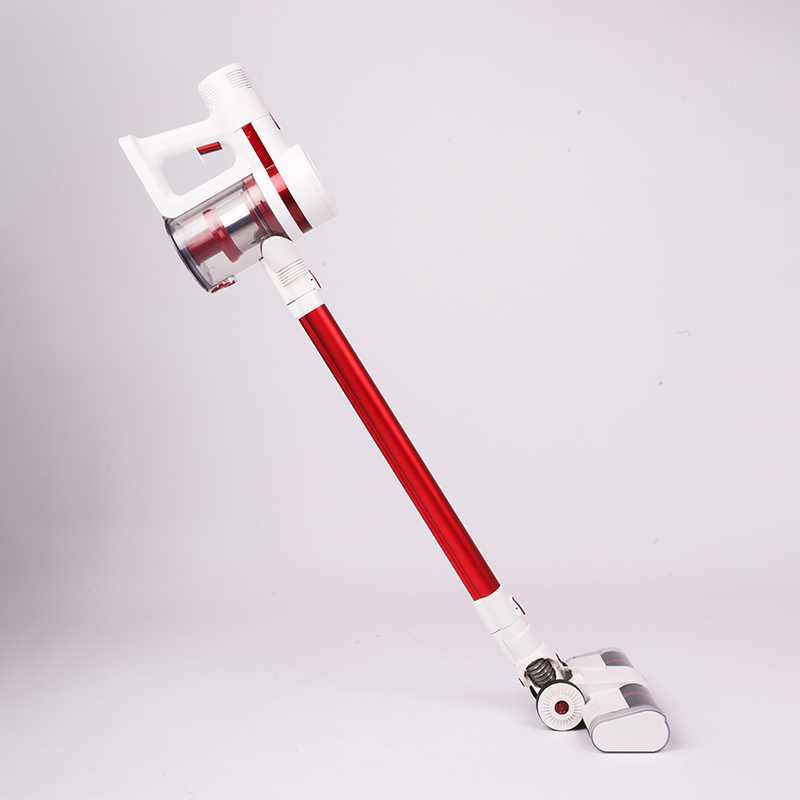
The rapid, lightweight, and spot-cleaning nature of cordless stick vacuums makes them almost exclusively bagless. Space constraints and strict weight limits dictate a compact cyclonic design. A bag requires a large, rigid housing to expand fully, which contradicts the slim profile required for a stick vacuum to reach under low furniture.
Conversely, heavy-duty, deep-cleaning uprights and canisters benefit heavily from bagged systems. Larger motor capacities and higher airflow volumes match the space requirements of large synthetic bags. These full-sized machines provide sustained power for whole-house cleaning, where the capacity of a 4-liter bag vastly outperforms a 0.7-liter plastic dust cup.
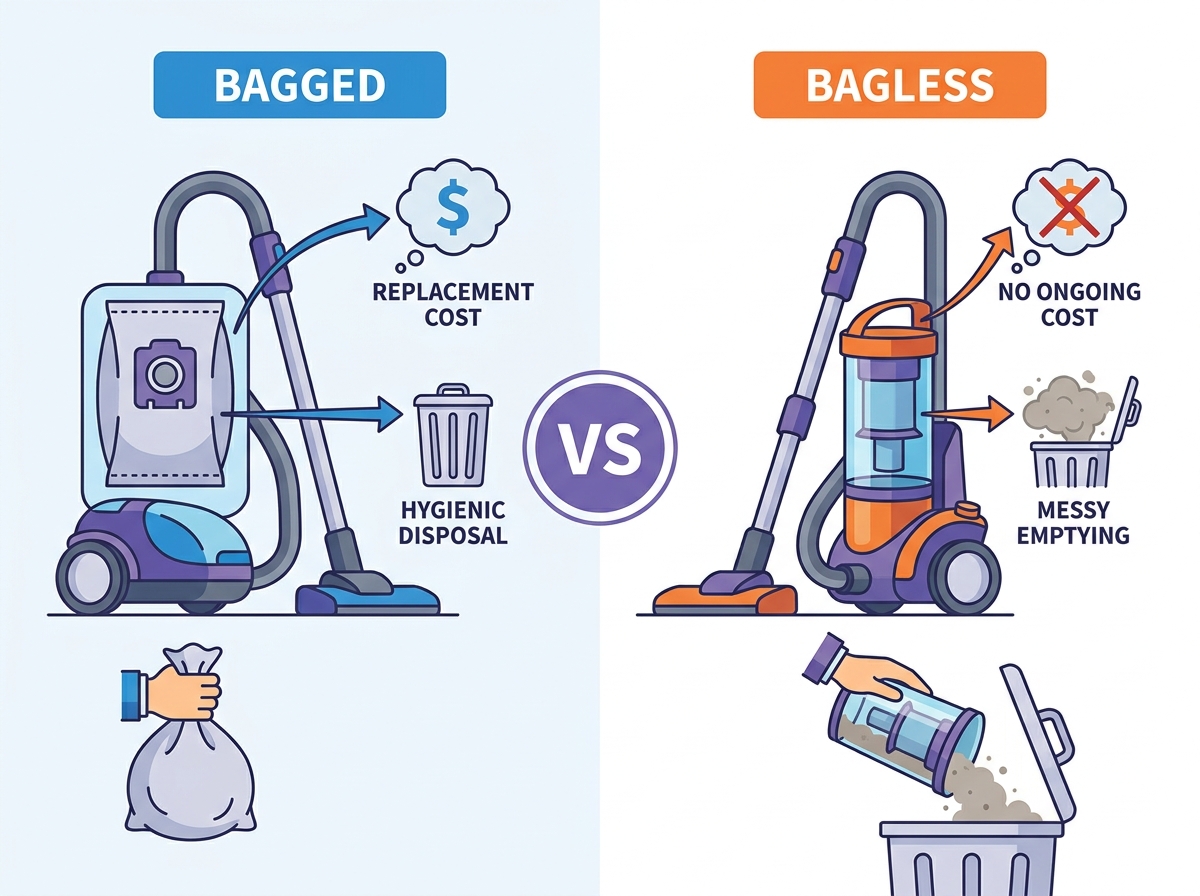
The disposal experience highlights the starkest mechanical contrast between the two systems. Premium bagged models feature self-sealing collars. When you open the machine housing, a spring-loaded plastic or rubber flap snaps shut over the bag inlet. You remove the bag and throw it away without ever seeing or touching the dirt. Emptying a bagless dirt cup often results in a visible "dust cloud" effect. When the bottom trapdoor opens, the sudden rush of air and gravity forces fine dust back up into the user's breathing zone. Users frequently report inhaling aerosolized dust and dander during the bin dumping process.
For asthma and allergy sufferers, bagged systems offer a distinct, non-negotiable mechanical advantage. Debris remains entirely encapsulated from the floor to the outdoor trash can. In dry climates or high-altitude regions, static charges build up rapidly in plastic bagless canisters. This static causes fine dust, pet dander, and hair to cling aggressively to the internal walls and the central metal shroud. Gravity alone will not empty the bin; the user must reach inside and manually scrape the debris out.
Odor management also differs greatly based on the architecture. Bagged systems, especially those equipped with activated charcoal layers, contain pet odors effectively. The dirt is removed from the home entirely when the bag is tossed. Bagless dirt cups harbor odor-causing bacteria in unwashed crevices, rubber gaskets, and pleated filters. Over time, this leads to a stale, dirty dog smell exhausting from the machine during operation.
Modern synthetic bags maintain suction until they are nearly at maximum capacity. The airflow path remains clear through the massive surface area of the multi-layered fabric. The dirt fills from the bottom up, leaving the top surface area of the bag free to exhaust air. Bagless vacuums can experience significant suction drops if the max-fill line is exceeded by even a fraction of an inch. Once debris reaches the central cyclonic shroud, it disrupts the vortex, sending dirt directly into the pre-motor filter.
Bagless systems rely heavily on washable foam or pleated paper filters to protect the motor. When these filters clog with fine dust, they severely restrict motor airflow. A restricted motor runs hotter and works harder to pull air. Regular, meticulous maintenance is absolutely required to keep a bagless machine performing at its peak. If you neglect the pre-motor filter, the machine will lose half its suction power within a few weeks of heavy use.
Throwing away synthetic bags regularly carries a documented environmental cost. The bags are made of non-biodegradable plastics and synthetic fibers. However, the hidden plastic waste of bagless systems must be weighed against this. Discarding unrecyclable, plastic-housed HEPA filters every six months contributes heavily to landfill waste. Furthermore, the shorter overall lifespan of many budget bagless machines means the entire unit—motor, plastic chassis, and wiring—often ends up discarded prematurely when the motor burns out from poor filtration.
Operating a bagless machine requires strict adherence to maintenance schedules. Failing to follow these steps results in immediate performance drops and potential hardware failure. The maintenance burden is physical and time-consuming.
Empty the bin after every use: Never store the machine with dirt in the cup, as this breeds bacteria and compresses the debris.
Disassemble the shroud: Remove the central cyclone assembly and manually pull off tangled hair and dust bunnies.
Wash the pre-motor filters: Rinse foam and felt filters under cold water until the water runs completely clear.
Execute strict drying protocols: Allow washed filters 24 to 48 hours to dry completely in a well-ventilated area. Installing a damp filter leads to instant mold growth, severe mildew odors, and potential moisture damage to the motor.
Wipe down the gaskets: Clean the rubber seals around the dirt cup trapdoor to ensure a proper vacuum seal is maintained.
Relying on a bagged system means relying on the manufacturer's supply chain. There is a risk that a manufacturer may discontinue a specific bag style for older or niche models, rendering the machine useless. Furthermore, the counterfeit market poses a massive threat to machine longevity. Cheap, third-party paper bags lack proper filtration media and structural integrity. They frequently tear under high suction, leaking fine dust directly into the vacuum motor chamber. This destroys the motor bearings and instantly voids manufacturer warranties. You must always source genuine, OEM synthetic bags to protect the hardware.

A bagged vacuum is the superior choice for allergy and asthma sufferers, pet owners seeking strict odor control, and users in dry climates prone to static buildup. It is also the mandatory choice for those investing in a durable machine meant to last over a decade. The sealed architecture protects the motor from grit, ensuring long-term reliability. The key compromise is accepting the ongoing, minor operational requirement of sourcing and storing proprietary bags.
A bagless vacuum suits users who clean highly frequently in small bursts, or those who accidentally vacuum up small valuables like jewelry or toy parts and need easy retrieval. It is also preferred by those who strictly refuse to manage consumable inventory. The key compromise is accepting frequent, hands-on, and potentially messy maintenance to keep the machine running optimally. You trade the financial cost of bags for the physical time spent washing filters and scraping out dirt cups.
The choice between a bagged vs bagless vacuum depends on your cleaning priorities rather than which technology is universally better. By considering filtration performance, suction consistency, maintenance requirements, and indoor air quality, you can select a vacuum cleaner that delivers reliable performance, easier maintenance, and a healthier living environment.
About SNDVAC
SNDVAC is a professional vacuum cleaner manufacturer specializing in cordless, upright, handheld, canister, and wet & dry vacuum cleaners. With advanced manufacturing technology, comprehensive quality control, and flexible OEM/ODM solutions, SNDVAC provides innovative vacuum cleaning products designed to deliver powerful suction, efficient filtration, and dependable long-term performance for customers worldwide.
Choose a bagged vacuum if hygiene, allergen control, and low-maintenance operation are your highest priorities.
Choose a bagless vacuum if you prefer lightweight designs and want to avoid purchasing replacement bags.
Maintain filters, dust containers, and sealing components regularly to preserve suction performance and extend product lifespan.
Select products from manufacturers that offer reliable filtration systems, durable construction, and professional technical support.
Before purchasing a vacuum cleaner, evaluate filtration efficiency, suction consistency, maintenance requirements, dust disposal hygiene, and overall product quality to find the solution that best fits your home and cleaning habits.
A: Yes, bagless vacuums lose suction rapidly if pre-motor filters become clogged with fine dust. Synthetic bags maintain airflow even as they fill with debris, whereas clogged foam filters in bagless models severely restrict the motor's ability to pull air.
A: Bagged vacuums excel at containing pet dander and neutralizing odors. The sealed synthetic bags prevent microscopic dander aerosolization during disposal and completely resist the static cling that plagues plastic bagless bins.
A: For an average household, a high-capacity synthetic bag typically lasts 1 to 3 months. This equates to using only 3 to 4 bags per year, making the actual physical maintenance frequency exceptionally low.
A: Many bagless vacuums use post-motor HEPA filters to clean the exhaust air. However, this is separate from the primary dirt separation stage, meaning fine dust still reaches and clogs the pre-motor filters before hitting the HEPA media.
A: Commercial cleaners rely on bagged models for their massive debris capacity, superior motor longevity, and the ability to quickly swap bags on a job site without waiting 24 hours for washed filters to dry.
A: Cordless stick vacuums require highly compact, lightweight designs to clean above floors and under low furniture. Bagless cyclonic systems fit these strict space and weight constraints much better than bulky bag compartments.


