
- All
- Product Name
- Product Keyword
- Product Model
- Product Summary
- Product Description
- Multi Field Search
Views: 0 Author: Site Editor Publish Time: 2026-07-24 Origin: Site


Lithium-ion battery technology has advanced rapidly over the last decade. This progress blurred the historical performance gap between battery-operated and wall-powered cleaning appliances. Homeowners now face a saturated market where marketing claims obscure actual mechanical capabilities. You might misjudge your specific cleaning requirements. This leads to purchases that either lack the necessary suction for deep-pile carpets or sacrifice daily convenience for unnecessary raw power. Under-buying leaves embedded dirt and causes premature carpet wear. Over-buying creates friction in your daily maintenance routines.
Choosing between a corded vs cordless vacuum requires matching airflow specifications, battery life realities, and long-term maintenance expectations to specific floorplans and lifestyle habits. You need a thorough understanding of how these machines operate under load. This prevents buyer's remorse and ensures your home environment remains consistently clean.
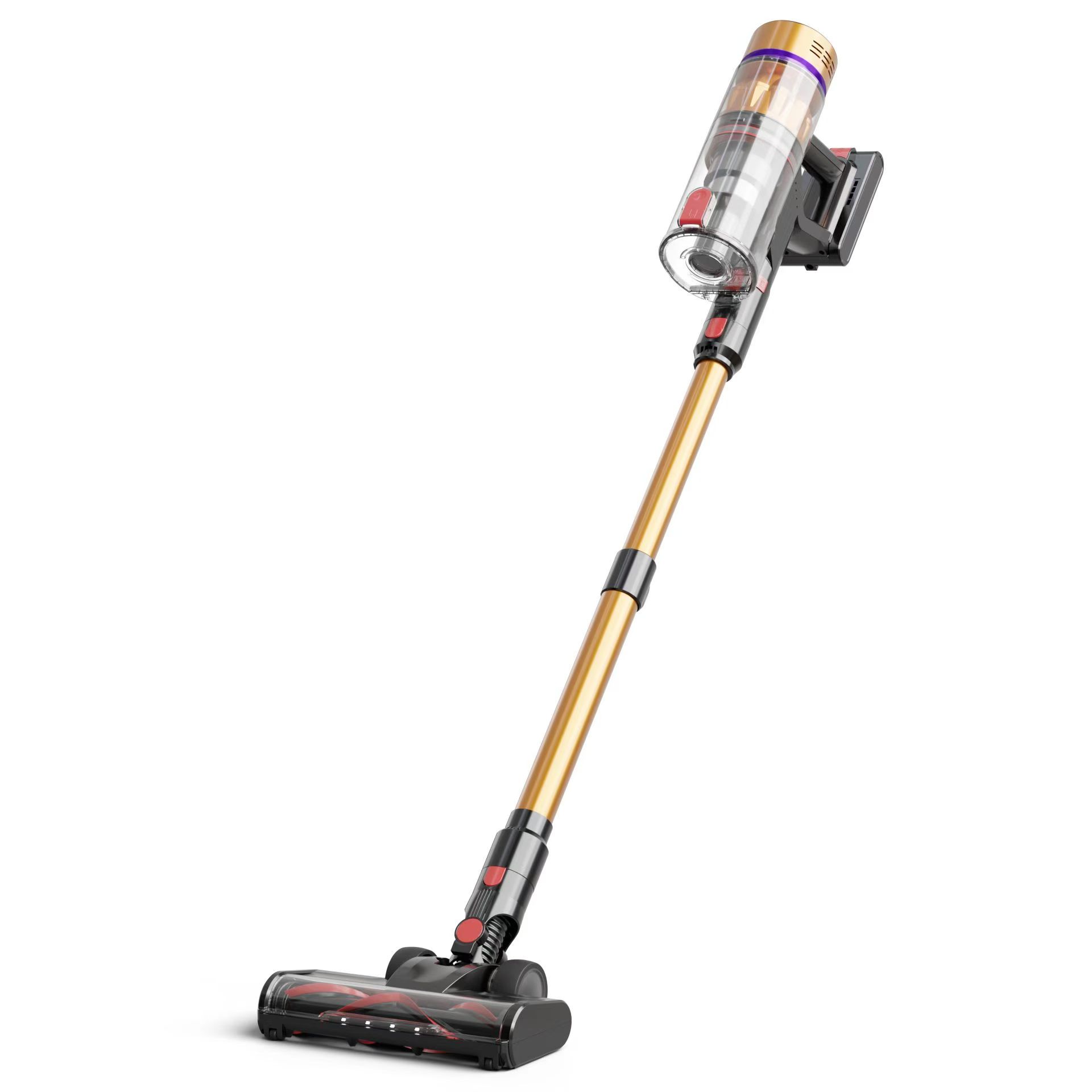
Raw Power vs. Agility: Corded vacuums consistently deliver higher Air Watts (AW) and Cubic Feet per Minute (CFM) without drop-off, making them mandatory for homes with extensive thick carpeting or heavy pet hair.
The Battery Bottleneck: Cordless vacuums offer unmatched daily convenience and maneuverability, but buyers must account for limited runtimes on "Max" settings and the inevitable cost of battery replacement every 3 to 5 years.
The Hybrid Approach: For multi-level homes exceeding 2,000 square feet, the optimal solution often involves deploying a heavy-duty corded unit for weekly deep cleans and a mid-range cordless vacuum for daily maintenance.
Table of Contents
You must audit your home's specific cleaning demands before evaluating hardware specifications. A vacuum cleaner is a utility tool. Its effectiveness depends entirely on the environment it operates within. Start by mapping out the ratio of hard floors to carpeted areas. Identify high-traffic zones, note the presence of shedding pets, and evaluate the physical layout of your living space. This baseline audit dictates the required suction metrics, filtration standards, and physical form factor of your ideal machine.
Calculate the exact square footage of carpet versus hard flooring.
Count the number of staircases and floor levels.
Identify the primary types of debris (e.g., fine dust, heavy sand, long pet hair).
Locate available power outlets in large, open rooms.
Floorplan size and architectural layout directly dictate the viability of tethered versus battery-powered units. Single-story apartments or homes under 1,500 square feet often suit battery-operated models. You can typically cover the entire space on a single charge. Sprawling multi-level homes introduce logistical challenges. Navigating stairs with a heavy upright machine increases the risk of injury and damage to walls. Large open floorplans require sustained runtime that often exceeds the capacity of standard lithium-ion batteries. This makes a corded unit highly practical if outlets are strategically placed.
Hardwood, tile, and laminate floors require surface-level suction. The primary goal is to lift loose debris without scattering it. Medium-to-high pile carpets demand an entirely different mechanical approach. Deep brush-roll agitation separates carpet fibers and dislodges embedded dirt, sand, and pet dander. A machine designed primarily for hard floors will glide over thick carpets. It leaves abrasive particles trapped near the backing pad, which accelerates carpet degradation over time.
Deep-set dirt removal relies heavily on active motor torque spinning the brush-roll, not just raw static lift. Static suction simply pulls air through the machine. Mechanical agitation physically beats the carpet fibers. When evaluating a cordless vacuum against a wall-powered alternative, pay close attention to the motorized cleaner head. Machines that prioritize battery conservation often reduce brush-roll torque. This results in inferior deep-cleaning performance even if the static suction numbers appear competitive on paper.
Homes with multiple pets require sustained high-velocity airflow and sealed HEPA filtration systems. Pet hair clings stubbornly to upholstery and weaves itself into carpet fibers. Extracting it requires aggressive agitation and continuous suction power. Pet dander and microscopic allergens must be trapped within the machine. Unsealed systems allow fine particulate matter to exhaust back into the room. Heavy-duty filtration systems add weight and aerodynamic resistance. Wall-powered motors handle this easily. Battery-powered motors struggle to push through dense filters without draining capacity rapidly.
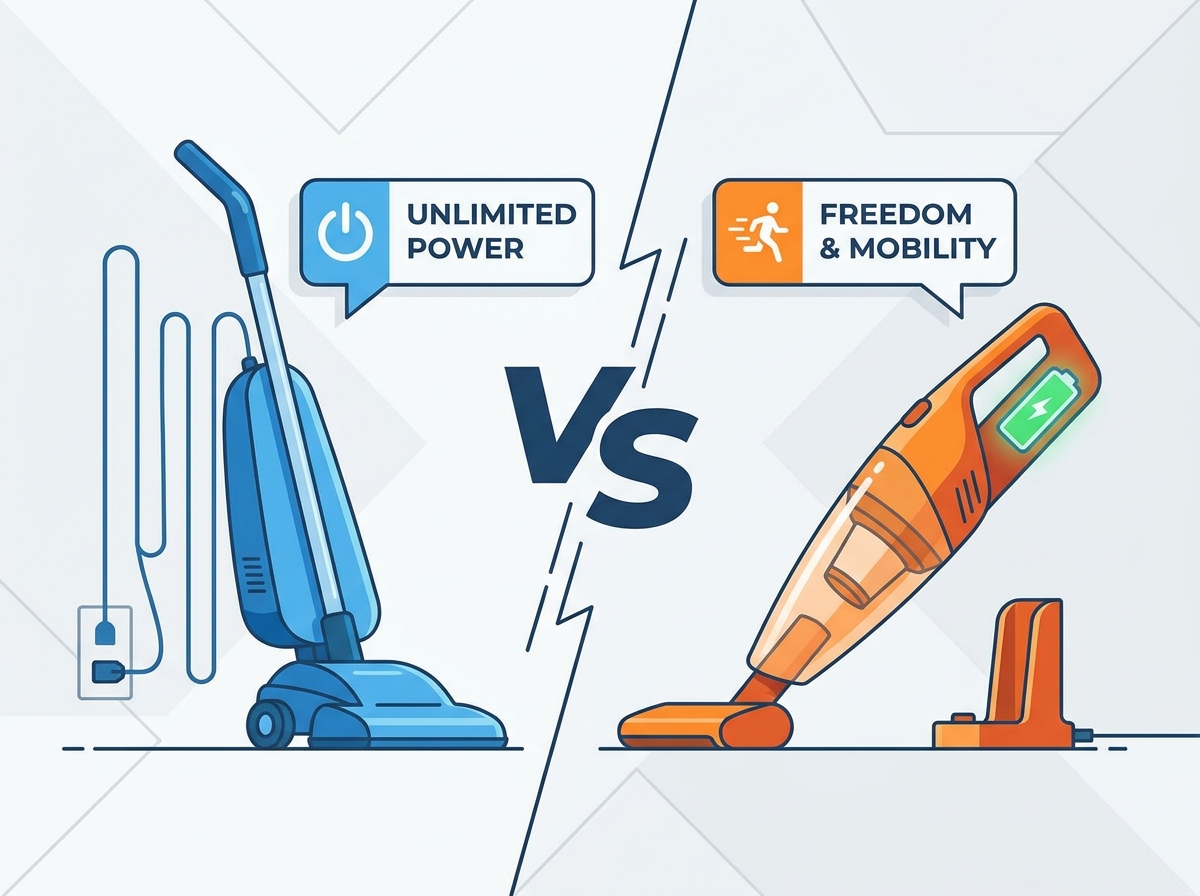
A continuous 120V power supply translates directly to sustained motor performance. Wall-powered machines generate higher Cubic Feet per Minute (CFM) and aggressive brush-roll torque without experiencing thermal throttling or power fade. As the dustbin fills and airflow restriction increases, a wall-powered motor simply draws more amperage to maintain performance. This brute-force approach ensures that the first minute of cleaning is just as effective as the sixtieth minute. It provides unparalleled consistency for heavy-duty remediation tasks.
The absence of battery degradation serves as a primary factor in the extended lifespan of traditional upright and canister models. Without volatile chemical power sources that degrade with every charge cycle, these machines routinely operate effectively for over a decade. The internal components are designed for endurance rather than weight reduction. Heavier gauge wiring, robust motor housings, and durable polycarbonate chassis materials contribute to a machine that withstands years of physical impacts and continuous vibration.
Traditional wall-powered vacuums feature highly modular components. Replacement belts, brush-rolls, and filters are standardized and widely available. Robust independent repair networks exist to service these machines. You can replace a worn drive belt or a clogged hose in minutes. This modularity ensures that a single component failure does not render the entire appliance obsolete. It offers superior long-term utility and reduces household waste.
Larger dustbins and heavier, multi-stage sealed filtration systems are easily supported by a non-portable chassis. A standard upright machine typically holds three to four times the volume of debris compared to a stick model. This massive capacity reduces the frequency of maintenance interruptions during large cleaning sessions. The powerful motors push air through dense, hospital-grade HEPA filters without compromising suction at the floor head. This ensures superior indoor air quality.
Specification | Standard Upright (Wall-Powered) | Standard Stick (Battery-Powered) |
|---|---|---|
Average Airflow (CFM) | 100 - 150 CFM | 40 - 80 CFM |
Dustbin Capacity | 1.5L - 3.5L | 0.4L - 0.8L |
Continuous Runtime | Unlimited | 10 - 45 Minutes |
Average Weight | 14 - 20 lbs | 5 - 8 lbs |
Despite their power, these machines present distinct physical drawbacks. Heavier unit weights cause user fatigue during extended use. The limited reach radius requires frequent outlet swapping, interrupting the workflow. Storage footprint is substantial, demanding dedicated closet space. Navigating tight corners, cleaning vehicle interiors, or reaching ceiling cobwebs is often cumbersome. You have to attach unwieldy hoses and secondary tools.
Manufacturer runtime claims require careful deconstruction. Advertised figures often highlight "Eco" mode runtimes. These can reach 40 to 60 minutes but provide minimal suction suitable only for light surface dust on hard floors. The reality of "Boost" or "Max" mode yields only 7 to 12 minutes of operational time. You absolutely need this high power for intensive carpet cleaning or pulling pet hair from upholstery. Users must constantly toggle power modes to balance cleaning efficacy with battery conservation.

The modularity of a battery-powered stick vacuum transforms household maintenance. You can quickly convert the unit into a handheld device. This makes it vastly superior for cleaning stairs, vehicle interiors, and responding immediately to dry spills in the kitchen. The absence of a tether allows users to move seamlessly from room to room. It drastically reduces the psychological friction associated with dragging a heavy machine out of storage for a quick five-minute cleanup.
Lithium-ion battery packs possess a finite lifespan dictated by charge cycles and thermal stress. High-draw applications generate significant heat that accelerates chemical degradation. Within 36 to 60 months of regular use, the battery will inevitably lose its ability to hold a full charge. This results in drastically reduced runtimes and unexpected shutdowns. Buyers must anticipate the necessity of purchasing replacement battery packs to maintain the machine's original performance levels.
The sustainability considerations of discarded lithium-ion battery packs present a growing environmental challenge. The highly integrated digital electronics, LCD screens, and proprietary smart sensors found in modern stick models are prone to failure. They are difficult to repair independently. When a proprietary mainboard fails, the entire unit often becomes e-waste. This contrasts sharply with the repairable mechanical nature of traditional machines.
Most modern stick models utilize a top-heavy design where the motor, battery, and dustbin are located near the handle. The entire weight of the machine is supported by the user's wrist and forearm. The overall unit weight is lower than a traditional upright. However, the unbalanced weight distribution causes significant ergonomic strain during extended cleaning sessions. This affects users with limited grip strength or wrist mobility.
Wall-powered units demonstrate clear superiority when extracting embedded sand and dirt from carpet padding over a sustained 30-minute cleaning session. A battery-powered unit will begin to experience power fade as the battery drains and the internal temperature rises. The wall-powered unit maintains maximum static lift and airflow from start to finish. It ensures that dense carpet fibers are thoroughly agitated and deep-set particulate matter is successfully extracted.
Wall-powered models utilize raw, unchecked motor torque to chop or pull long hair through anti-wrap systems. The sheer force prevents the brush-roll from bogging down. Battery-powered models must balance anti-wrap technology with power conservation. If the brush-roll encounters heavy resistance from tangled hair, the internal software will often shut down the cleaner head. This prevents motor burnout and preserves battery life, but it requires manual intervention from the user.

The low-profile reach of stick models allows them to lay almost completely flat. They easily navigate under sofas, beds, and low-clearance furniture. The motorized cleaner heads are highly articulated, turning sharply with a simple twist of the wrist. Traditional bulky units feature large floor heads and rigid bodies that physically cannot fit under most furniture. You have to move heavy items or rely on less effective hose attachments to clean those areas.
The compact nature of a stick model dictates a smaller dustbin, typically ranging from 0.5 to 0.8 liters. In homes with shedding pets, this bin fills rapidly. You will make multiple trips to the trash can during a single cleaning session. Traditional machines feature capacities ranging from 1.5 to over 3 liters. This massive volume allows users to clean an entire large home without stopping, significantly improving workflow efficiency.
Maintaining motorized cleaner heads, washing multiple foam filters, and managing wall-mounted charging docks requires consistent attention. Battery-powered units rely on complex digital sensors to monitor airflow and battery health. These malfunction if exposed to fine dust or moisture. Traditional machines require simpler maintenance routines. You replace a bag, swap a belt, and utilize simple cord-wrap storage. The mechanical simplicity translates directly to higher long-term reliability.
Feature | Wall-Powered (Corded) | Battery-Powered (Cordless) |
|---|---|---|
Sustained Suction | Excellent - No power fade | Variable - Drops as battery depletes |
Carpet Agitation | High Torque - Deep extraction | Moderate - Balances torque with battery life |
Maneuverability | Low - Bulky, limited by tether | High - Lightweight, highly articulated |
Maintenance Complexity | Low - Mechanical, modular parts | High - Digital sensors, battery management |
A high-quality wall-powered machine generally represents a long-term household appliance investment. The robust construction and lack of degrading power cells mean the machine will likely serve the household for a decade or more with minimal maintenance. A battery-powered unit is often a mid-term convenience purchase. The initial investment must be weighed against the inevitable need for replacement parts and the shorter overall lifespan of the integrated electronics.
An entry-to-mid-tier wall-powered machine consistently outperforms even the most premium, high-end battery-powered models when it comes to deep carpet remediation. Consumers often assume that spending top dollar on the latest battery technology guarantees superior cleaning performance. The laws of physics dictate that a continuous 120V power supply will always generate more raw mechanical force than a portable lithium-ion pack. You pay a premium for miniaturization and convenience, not raw extraction power.
Household dynamics change. Moving from a small apartment to a larger home, or adopting a heavy-shedding pet, instantly alters your cleaning requirements. A budget battery-powered unit will quickly become obsolete under increased demand. It struggles to handle the volume of debris or the extended square footage. A robust wall-powered unit scales effortlessly with increased demand. It handles larger spaces and heavier soil loads without requiring an immediate hardware upgrade.
If you determine that a battery-powered unit best fits your lifestyle, mitigate your purchase risk by selecting a brand that utilizes removable, swappable battery ecosystems. This allows you to double your runtime immediately and replace dead cells easily in the future without discarding the entire machine. If selecting a wall-powered unit, evaluate the tether length carefully. A minimum of 25 to 30 feet is required to ensure you can clean large rooms without constantly searching for new outlets.
The choice between a corded vs cordless vacuum depends on your home's layout, cleaning habits, flooring types, and long-term maintenance expectations. By comparing suction performance, battery runtime, maneuverability, durability, and overall convenience, you can select the vacuum cleaner that best fits your lifestyle and delivers consistent cleaning performance.
About SNDVAC
SNDVAC is a professional vacuum cleaner manufacturer specializing in cordless stick vacuums, corded upright vacuums, handheld vacuums, canister vacuums, and wet & dry cleaning solutions. With advanced manufacturing technology, strong R&D capabilities, strict quality management, and flexible OEM/ODM services, SNDVAC delivers innovative vacuum cleaners that combine powerful suction, efficient filtration, ergonomic design, and dependable long-term performance for customers worldwide.
Choose a corded vacuum for maximum suction, deep carpet cleaning, and large homes.
Choose a cordless vacuum for lightweight daily cleaning, quick pickups, and greater mobility.
Compare battery life, filtration performance, storage space, and maintenance requirements before purchasing.
Select products from manufacturers that provide reliable quality, advanced technology, and professional after-sales support.
Before purchasing a vacuum cleaner, evaluate suction power, runtime, filtration efficiency, maneuverability, durability, and overall product quality to choose the best solution for your home and cleaning routine.
A: Yes. Wall-powered machines draw continuous amperage from a 120V outlet, allowing them to generate significantly higher Air Watts and sustained static lift. Battery-powered units must restrict motor draw to conserve energy, resulting in lower overall suction, especially as the battery depletes.
A: On maximum or boost settings, most lithium-ion batteries will only last between 7 and 12 minutes. The advertised 40 to 60-minute runtimes are achieved using the lowest suction settings, which are generally only effective for light dust on hard floors.
A: It depends on your home. In small apartments with hard floors, a battery-powered unit is sufficient. In large homes with thick carpets and pets, a battery-powered unit lacks the sustained torque and capacity required for deep cleaning, making a complete replacement impractical.
A: They struggle with high-pile carpets. Effective deep cleaning requires aggressive mechanical agitation and sustained high suction to pull dirt from the carpet padding. Battery-powered units often lack the necessary brush-roll torque and will drain rapidly when forced to push through dense fibers.
A: A well-maintained wall-powered machine typically lasts 8 to 12 years due to its robust mechanical parts. A battery-powered unit usually lasts 3 to 5 years before the lithium-ion battery degrades significantly, requiring a replacement pack to restore functionality.
A: It is excellent for quick daily pickups of visible pet hair on hard floors or furniture. For extracting embedded dander and hair from carpets, you will still need a wall-powered machine to provide the necessary agitation and sustained suction.


